



Text Diff Checker — Free HTML CSS JS Word-Level Diff Snippet
Text Diff Checker · Dev · Plain HTML, CSS & JS · Live preview
Copy & paste
Source Code
<div class="tdc-card">
  <h3>Text Diff Checker</h3>
  <p class="tdc-sub">Word-level comparison between two blocks of text, computed client-side.</p>
  <div class="tdc-inputs">
    <div class="tdc-col">
      <label>Original</label>
      <textarea id="tdcA">The quick brown fox jumps over the lazy dog near the river.</textarea>
    </div>
    <div class="tdc-col">
      <label>Changed</label>
      <textarea id="tdcB">The quick brown fox leaps over the sleepy dog by the river bank.</textarea>
    </div>
  </div>
  <button class="tdc-btn" id="tdcCompare">Compare</button>
  <div class="tdc-result" id="tdcResult">
    <div class="tdc-legend"><span class="tdc-swatch tdc-del"></span> removed <span class="tdc-swatch tdc-add"></span> added</div>
    <div class="tdc-output" id="tdcOutput"></div>
  </div>
</div>*{box-sizing:border-box;margin:0;padding:0}
body{font-family:system-ui,-apple-system,sans-serif;background:#f8fafc;min-height:100vh;display:flex;align-items:center;justify-content:center;padding:24px}
.tdc-card{background:#fff;border-radius:16px;padding:26px 28px;width:100%;max-width:640px;box-shadow:0 4px 24px rgba(15,23,42,.08)}
.tdc-card h3{font-size:16px;font-weight:800;color:#0f172a;margin-bottom:4px}
.tdc-sub{font-size:12.5px;color:#64748b;margin-bottom:18px}
.tdc-inputs{display:grid;grid-template-columns:1fr 1fr;gap:14px;margin-bottom:14px}
.tdc-col label{display:block;font-size:11px;font-weight:700;text-transform:uppercase;letter-spacing:.04em;color:#94a3b8;margin-bottom:6px}
.tdc-col textarea{width:100%;min-height:90px;padding:10px 12px;border:1.5px solid #e2e8f0;border-radius:9px;font-family:ui-monospace,SFMono-Regular,Menlo,monospace;font-size:12.5px;line-height:1.6;resize:vertical;outline:none;color:#1e293b}
.tdc-col textarea:focus{border-color:#6366f1}
.tdc-btn{padding:10px 20px;background:#6366f1;color:#fff;border:none;border-radius:9px;font-size:13.5px;font-weight:700;cursor:pointer;margin-bottom:18px}
.tdc-btn:hover{background:#4f46e5}
.tdc-legend{font-size:11.5px;color:#64748b;display:flex;align-items:center;gap:6px;margin-bottom:10px}
.tdc-swatch{width:11px;height:11px;border-radius:3px;display:inline-block}
.tdc-swatch.tdc-del{background:#fecaca}
.tdc-swatch.tdc-add{background:#bbf7d0}
.tdc-output{background:#f8fafc;border:1px solid #e2e8f0;border-radius:10px;padding:14px 16px;font-size:13.5px;line-height:2;color:#334155;word-break:break-word}
.tdc-output del{background:#fecaca;color:#991b1b;text-decoration:line-through;text-decoration-color:rgba(153,27,27,.5);border-radius:3px;padding:1px 3px;margin:0 1px}
.tdc-output ins{background:#bbf7d0;color:#065f46;text-decoration:none;border-radius:3px;padding:1px 3px;margin:0 1px}
@media (max-width:520px){.tdc-inputs{grid-template-columns:1fr}}(function(){
var aInput = document.getElementById('tdcA');
var bInput = document.getElementById('tdcB');
var btn = document.getElementById('tdcCompare');
var output = document.getElementById('tdcOutput');
function tokenize(text) {
// split on whitespace, keeping the whitespace as its own token so spacing survives
return text.split(/(\s+)/).filter(function (t) { return t.length > 0; });
}
function escapeHtml(str) {
return str.replace(/&/g, '&').replace(/</g, '<').replace(/>/g, '>');
}
// Longest Common Subsequence table over word tokens, then backtrack to build
// a sequence of equal / delete / insert operations (classic Myers-style diff via DP).
function diffWords(a, b) {
var n = a.length, m = b.length;
var dp = new Array(n + 1);
for (var i = 0; i <= n; i++) dp[i] = new Array(m + 1).fill(0);
for (i = n - 1; i >= 0; i--) {
for (var j = m - 1; j >= 0; j--) {
dp[i][j] = a[i] === b[j] ? dp[i + 1][j + 1] + 1 : Math.max(dp[i + 1][j], dp[i][j + 1]);
}
}
var ops = [];
i = 0; var jj = 0;
while (i < n && jj < m) {
if (a[i] === b[jj]) { ops.push({ type: 'eq', text: a[i] }); i++; jj++; }
else if (dp[i + 1][jj] >= dp[i][jj + 1]) { ops.push({ type: 'del', text: a[i] }); i++; }
else { ops.push({ type: 'add', text: b[jj] }); jj++; }
}
while (i < n) { ops.push({ type: 'del', text: a[i] }); i++; }
while (jj < m) { ops.push({ type: 'add', text: b[jj] }); jj++; }
return ops;
}
function render() {
var ops = diffWords(tokenize(aInput.value), tokenize(bInput.value));
output.innerHTML = ops.map(function (op) {
var text = escapeHtml(op.text);
if (op.type === 'del') return '<del>' + text + '</del>';
if (op.type === 'add') return '<ins>' + text + '</ins>';
return text;
}).join('');
}
btn.addEventListener('click', render);
render();
})();Extend with AI
Take This Snippet Further With AI
The AI prompt for this one is for Patreon supporters ($3 a month, 7 days free), along with a site with no ads. Supporters enter the passcode once and it is remembered in this browser.
What's included
Features
About this UI Snippet
Text Diff Checker — LCS Dynamic Programming Diff, No Library
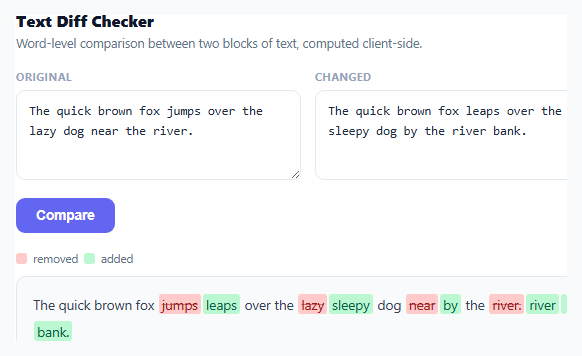
Comparing two versions of a document, contract, or paragraph word-by-word is exactly the kind of problem that looks trivial until you try to implement it — a naive character comparison produces useless, noisy output. This snippet implements a real longest common subsequence (LCS) diff algorithm from scratch in vanilla JavaScript, operating on whitespace-preserving word tokens instead of individual characters.
Tokenizing without losing whitespace
tokenize() splits on /(\s+)/ with a capturing group, which — unlike a plain split on whitespace — keeps every run of spaces, tabs, and newlines as its own token in the resulting array. That means the diff algorithm treats "quick brown" and "quick brown" (two spaces) as genuinely different token sequences, and reassembling the output never needs to guess where whitespace should go — it's already preserved token-for-token.
Building the LCS table bottom-up
dp[i][j] holds the length of the longest common subsequence between the tail of array a starting at index i and the tail of b starting at index j. The nested loop fills this table from the bottom-right corner backward: dp[i][j] = a[i] === b[j] ? dp[i+1][j+1] + 1 : Math.max(dp[i+1][j], dp[i][j+1]) — if the tokens match, extend the best subsequence found one cell diagonally; otherwise take whichever neighboring cell (skip a token from a, or skip one from b) gives the longer subsequence. This is the same core recurrence used by diff, git diff, and most text-comparison tools.
Backtracking to recover the actual edits
Once the table is built, a forward walk from (0, 0) reconstructs the operations: matching tokens are eq, and at a mismatch the walk follows whichever neighbor cell in the DP table has the larger value — dp[i+1][jj] >= dp[i][jj+1] — deciding whether this token was deleted from a or inserted from b. This greedy-looking walk is provably optimal because the table already encodes the best subsequence length at every position.
Rendering with real <del>/<ins> elements
Deleted tokens render inside <del> and inserted tokens inside <ins> — the semantically correct HTML elements for this exact purpose, not just styled <span>s — while every token is passed through escapeHtml() first so pasted text containing <, >, or & can't break the output markup.
Customizing it
Swap word-level tokenization for character-level (drop the whitespace-preserving regex and split on '') for finer-grained diffs, or add a line-level mode by tokenizing on \n first and running the same diffWords() function on lines instead of words.
Step by step
How to Use
- 1Paste HTML, CSS, and JSTwo sample paragraphs load with a diff already rendered below.
- 2Edit either text areaChange the "Original" or "Changed" text to whatever you want to compare.
- 3Click CompareThe diff output re-renders, showing removed words struck through in red and added words highlighted in green.
- 4Read the resultUnchanged words appear plain; only the actual differing spans are highlighted, not the whole line.
- 5Switch to character-level diffingIn tokenize(), remove the whitespace-preserving split and split the string into individual characters instead.
- 6Add line-level diffingTokenize on newlines first, run diffWords() on the resulting line arrays, then run it again within each changed line for word-level detail.
Real-world uses
Common Use Cases
del and ins elements so deletions and additions carry semantic meaning.Got questions?
Frequently Asked Questions
It builds a dynamic-programming table where dp[i][j] represents the length of the longest common subsequence between the remaining tokens of each text starting at positions i and j. Filling that table from the end backward, then walking it forward from the start while following whichever neighbor has the larger stored value, reconstructs the optimal sequence of matches, deletions, and insertions.
Character-level diffing on prose tends to produce noisy, hard-to-read output — a single added word can make every following character look "different" until things realign. Word-level tokens keep the diff granularity matched to how humans actually read changes: word by word, not letter by letter.
tokenize() splits using a regex with a capturing group around whitespace, /(\s+)/, which — unlike a normal split — includes the matched whitespace runs as their own array entries instead of discarding them. This means spacing differences are diffed and reconstructed exactly like word differences.
The DP table is O(n × m) in both time and memory, where n and m are the token counts of each text. That's fine for paragraphs and typical documents, but for very large files (thousands of lines) you'd want a line-level pre-pass first — diff at the line granularity, then only run this word-level diff on the lines that actually changed.
Yes — run diffWords() a second time, but on the individual characters of just the words marked del/add adjacent to each other, rather than on the full token arrays. This two-pass approach (word-level first, then character-level within changed spans) is how most polished diff tools get fine-grained highlighting.