


Three.js Scroll Asteroid Belt — InstancedMesh Dodge Run
Three.js Scroll Asteroid Belt Run · Scroll · Plain HTML, CSS & JS · Live preview
Copy & paste
Source Code
<section class="ast-stage" id="astStage">
  <div class="ast-intro"><p>Scroll ↓ to thread the belt</p></div>
  <canvas id="astCanvas"></canvas>
  <div class="ast-hud">NEAR MISSES <span id="astMiss">0</span></div>
</section>
<section class="ast-bottom"><p>Clear of the field.</p></section>*{box-sizing:border-box;margin:0;padding:0}
html,body{background:#07070d;color:#fff;font-family:system-ui,-apple-system,sans-serif}
.ast-bottom{min-height:70vh;display:flex;justify-content:center;align-items:center;color:#8d8da5;font-size:15px;letter-spacing:.08em;text-transform:uppercase}
.ast-stage{height:100vh;position:relative;overflow:hidden;background:#07070d}
.ast-intro{position:absolute;inset:0;display:flex;align-items:center;justify-content:center;text-align:center;padding:24px;pointer-events:none;z-index:5;color:#8d8da5;font-size:15px;letter-spacing:.08em;text-transform:uppercase;transition:opacity .4s ease}
#astCanvas{display:block;width:100%;height:100%}
.ast-hud{position:absolute;left:24px;bottom:24px;font-variant-numeric:tabular-nums;font-size:13px;letter-spacing:.14em;color:#fca5a5;text-transform:uppercase;opacity:.85}const canvas = document.getElementById('astCanvas');
const missEl = document.getElementById('astMiss');
const introEl = document.querySelector('.ast-intro');
const renderer = new THREE.WebGLRenderer({ canvas, antialias: true });
renderer.setPixelRatio(Math.min(window.devicePixelRatio, 2));
const scene = new THREE.Scene();
const BG = 0x07070d;
scene.background = new THREE.Color(BG);
scene.fog = new THREE.FogExp2(BG, 0.011);
const camera = new THREE.PerspectiveCamera(70, 1, 0.1, 400);
scene.add(new THREE.AmbientLight(0x8899bb, 0.4));
const sun = new THREE.DirectionalLight(0xffe9c9, 1.2);
sun.position.set(40, 25, 30);
scene.add(sun);
function rand(seed) {
const x = Math.sin(seed * 173.9 + 61.3) * 36241.7391;
return x - Math.floor(x);
}
// One InstancedMesh draws every asteroid — 320 rocks, one draw call.
// Each instance stores its corridor placement and tumble parameters;
// matrices are recomposed each frame from those plus clock time.
const COUNT = 320, DEPTH = 480;
const rockGeo = new THREE.DodecahedronGeometry(1, 0);
// Roughen the base rock so instances read as debris, not dice.
const rp = rockGeo.attributes.position;
const rv = new THREE.Vector3();
for (let i = 0; i < rp.count; i++) {
rv.fromBufferAttribute(rp, i);
rv.multiplyScalar(0.82 + rand(i) * 0.36);
rp.setXYZ(i, rv.x, rv.y, rv.z);
}
rockGeo.computeVertexNormals();
const rockMat = new THREE.MeshStandardMaterial({ color: 0x8a8578, roughness: 0.9, metalness: 0.15 });
const rocks = new THREE.InstancedMesh(rockGeo, rockMat, COUNT);
rocks.instanceMatrix.setUsage(THREE.DynamicDrawUsage);
scene.add(rocks);
// The flight path weaves: lateral offsets the camera will steer through.
function pathX(z) { return Math.sin(z * 0.021) * 9 + Math.sin(z * 0.007) * 5; }
function pathY(z) { return Math.cos(z * 0.016) * 5; }
const asteroids = [];
for (let i = 0; i < COUNT; i++) {
const z = -(i / COUNT) * DEPTH - 12;
// Place rocks around the path, but keep a flyable channel: minimum
// radial clearance from the path centerline, with a few "gate" rocks
// deliberately closer for near-miss drama.
const gate = rand(i + 7e3) > 0.88;
const clearance = gate ? 3.4 : 6.5;
const a = rand(i + 1e3) * Math.PI * 2;
const r = clearance + rand(i + 2e3) * 16;
asteroids.push({
x: pathX(z) + Math.cos(a) * r,
y: pathY(z) + Math.sin(a) * r,
z,
scale: gate ? 1.2 + rand(i + 3e3) * 1.6 : 0.7 + rand(i + 3e3) * 3.4,
spinX: (rand(i + 4e3) - 0.5) * 0.8,
spinY: (rand(i + 5e3) - 0.5) * 0.8,
phase: rand(i + 6e3) * Math.PI * 2,
gate,
counted: false,
});
}
const dummy = new THREE.Object3D();
const rockColor = new THREE.Color(0x8a8578);
const hotColor = new THREE.Color(0xff8866);
rocks.instanceColor = null; // ensure per-instance color buffer allocates on first set
for (let i = 0; i < COUNT; i++) rocks.setColorAt(i, rockColor);
// Distant star dust.
const starGeo = new THREE.BufferGeometry();
const starPos = new Float32Array(1000 * 3);
for (let i = 0; i < 1000; i++) {
starPos[i * 3] = (rand(i + 9e3) - 0.5) * 300;
starPos[i * 3 + 1] = (rand(i + 1e4) - 0.5) * 300;
starPos[i * 3 + 2] = -rand(i + 11e3) * DEPTH - 40;
}
starGeo.setAttribute('position', new THREE.BufferAttribute(starPos, 3));
scene.add(new THREE.Points(starGeo, new THREE.PointsMaterial({ color: 0xaab4d4, size: 0.5, sizeAttenuation: true })));
gsap.registerPlugin(ScrollTrigger);
const flight = { z: 6 };
gsap.to(flight, {
z: -DEPTH - 6,
ease: 'none',
scrollTrigger: { trigger: '#astStage', start: 'top top', end: '+=600%', scrub: 0.55, pin: true },
});
function resize() {
const w = canvas.clientWidth, h = canvas.clientHeight;
renderer.setSize(w, h, false);
camera.aspect = w / h;
camera.updateProjectionMatrix();
}
let misses = 0;
const clock = new THREE.Clock();
function animate() {
requestAnimationFrame(animate);
const t = clock.getElapsedTime();
const cz = flight.z;
if (introEl) introEl.style.opacity = cz < 4 ? '0' : '1';
// The camera flies the weaving path; banking is the X-derivative of the
// path, which reads as steering rather than sliding.
const px = pathX(cz), py = pathY(cz);
const lead = 14;
camera.position.set(px, py, cz);
camera.lookAt(pathX(cz - lead), pathY(cz - lead), cz - lead);
const bank = (pathX(cz - 1) - pathX(cz + 1)) * 0.09;
camera.rotation.z = bank;
// Recompose every instance matrix: tumble from clock, proximity glow
// and count from camera distance.
let needColor = false;
for (let i = 0; i < COUNT; i++) {
const A2 = asteroids[i];
dummy.position.set(A2.x, A2.y, A2.z);
dummy.rotation.set(A2.phase + t * A2.spinX, A2.phase + t * A2.spinY, A2.phase * 0.5);
dummy.scale.setScalar(A2.scale);
dummy.updateMatrix();
rocks.setMatrixAt(i, dummy.matrix);
// Near-miss: gates within 6 units of the camera flash hot and count
// once per pass (reset when re-approached from the front).
const dz = A2.z - cz;
if (A2.gate) {
const close = Math.abs(dz) < 6;
if (close && !A2.counted && dz > -1) { A2.counted = true; misses++; }
if (dz > 6) A2.counted = false; // re-arm when scrolled back above it
rocks.setColorAt(i, close ? hotColor : rockColor);
needColor = true;
}
}
rocks.instanceMatrix.needsUpdate = true;
if (needColor && rocks.instanceColor) rocks.instanceColor.needsUpdate = true;
missEl.textContent = misses;
renderer.render(scene, camera);
}
resize();
window.addEventListener('resize', resize);
animate();Extend with AI
Take This Snippet Further With AI
The AI prompt for this one is for Patreon supporters ($3 a month, 7 days free), along with a site with no ads. Supporters enter the passcode once and it is remembered in this browser.
What's included
Features
About this UI Snippet
How to Build a Scroll-Driven Asteroid Belt Run With InstancedMesh and GSAP
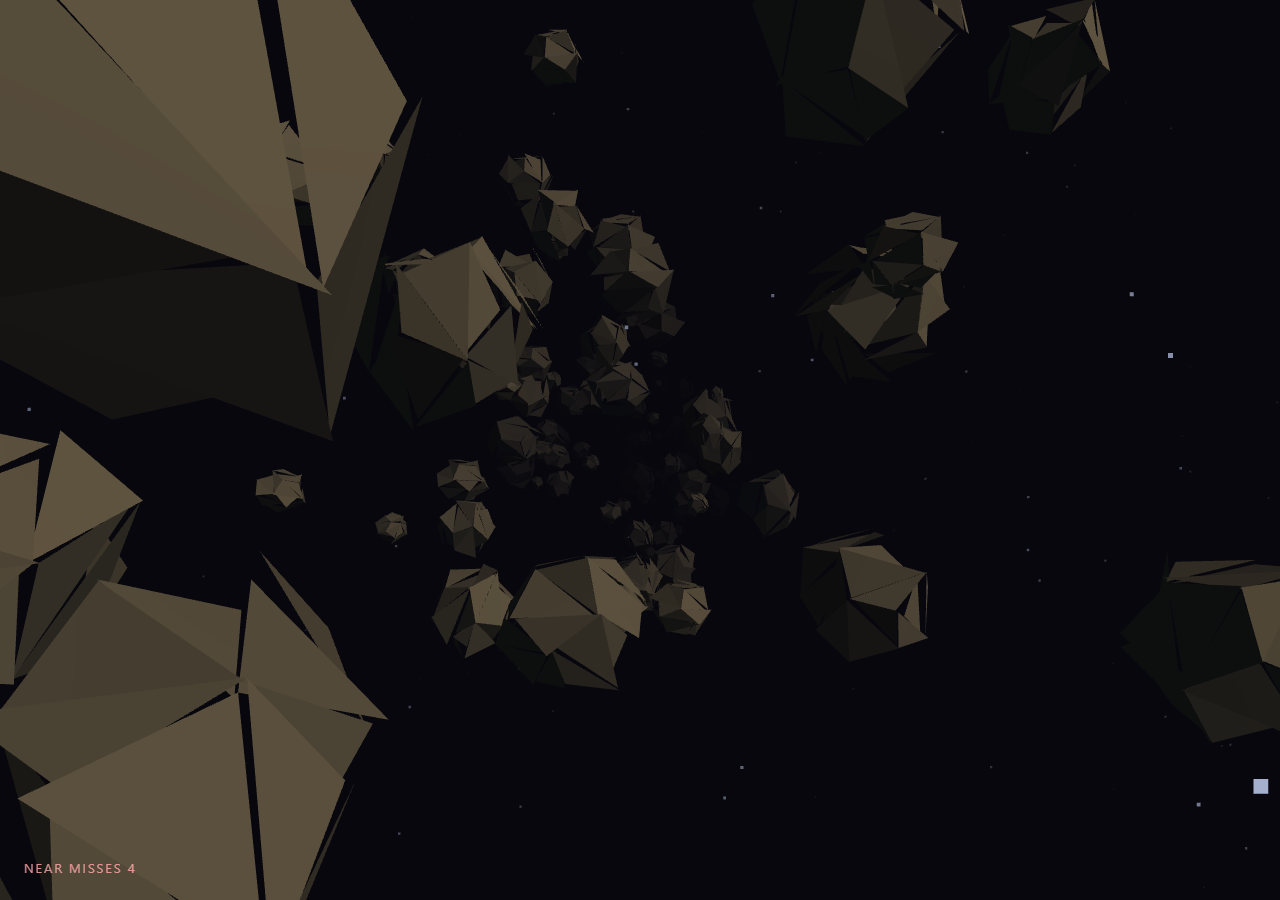
The Three.js Scroll Asteroid Belt Run snippet flies the camera on a weaving, banking path through 320 tumbling asteroids — every rock a single InstancedMesh instance, so the whole field costs one draw call — with "gate" asteroids seeded deliberately close to the flight path that flash hot and increment a NEAR MISSES counter as the camera threads them. GSAP's ScrollTrigger scrubs the camera's Z; the corridor, the banking, and the drama are all construction-time guarantees.
One draw call for the whole field
Rendering 320 individual Mesh objects means 320 draw calls and 320 scene-graph nodes. InstancedMesh submits one geometry, one material, and a buffer of per-instance matrices — the GPU stamps the rock 320 times in a single call. Each frame the loop recomposes every matrix through a shared Object3D dummy (position from placement, rotation from clock-time tumble, scale from seed) and flags instanceMatrix.needsUpdate. With DynamicDrawUsage hinting the driver that this buffer changes every frame, the field animates as cheaply as a particle system while remaining fully lit, shadowed, solid geometry. The base rock itself is a DodecahedronGeometry with seeded per-vertex radial jitter, so instances read as debris rather than dice.
A corridor guaranteed at construction
Dodge-field scenes fail when a rock happens to spawn on the flight path. Here the path is two analytic functions — pathX(z) and pathY(z), sums of incommensurate sines that weave without repeating — and every asteroid is placed *relative to the path at its own Z*: a random angle around the centerline at a radius of at least 6.5 units of clearance. The corridor is therefore flyable by construction, no collision testing ever needed. The 12% of rocks flagged as gates get clearance 3.4 instead — close enough to feel dangerous, still outside the camera's envelope. Threat placement is a parameter, not luck.
Banking sells the steering
A camera translated along a curve looks like it is being dragged; a camera that *banks* looks like it is flying. The roll angle is the numerical X-derivative of the path — (pathX(z−1) − pathX(z+1)) × 0.09 — so the camera leans into every turn exactly as hard as the turn demands, with look-at aimed 14 units down-path. One derivative turns a slide into a cockpit, the first-person sibling of the bridge crossing's footstep bob.
Near-misses with scrub-safe counting
Gate rocks within 6 units of the camera tint hot orange via setColorAt — per-instance color, still one draw call — and increment the counter once per pass. The counted flag re-arms only when the camera retreats fully above the gate, so oscillating mid-pass cannot double-count, and scrolling back up genuinely re-arms the gates for another run. It is the honest-counter philosophy of the portal gate sequence adapted to stateful counting on a scrubbed axis.
Fog as density illusion
FogExp2 matched to the background makes rocks materialize gradually out of the dark ahead — the belt feels endless although only 320 rocks exist across 480 units, the same budget-infinity trick as the scroll tunnel. Star dust points scattered through the corridor depth supply parallax between rock encounters. For the physics-flavored cousin where the field reacts to you, see magnetic particles; for the warp-speed version with no obstacles, starfield warp.
Step by step
How to Use
- 1Load the three CDN scriptsAdd three.min.js, gsap.min.js, and ScrollTrigger.min.js in that order before the snippet JS.
- 2Paste HTML, CSS, and JSYou hover at the edge of a fog-shrouded asteroid field, rocks tumbling ahead — NEAR MISSES 0 in the HUD.
- 3Scroll to flyThe camera weaves and banks along the corridor as asteroids materialize from the fog and slide past on both sides.
- 4Thread the gatesOccasional rocks sit deliberately close — they flash hot orange as you pass and the near-miss counter ticks up.
- 5Scroll backThe run reverses; gates re-arm as you retreat above them, ready to count again on the next pass.
- 6Tune the dangerRaise the gate probability (0.88 threshold), lower gate clearance (3.4), or add rocks — the corridor stays flyable by construction.
Real-world uses
Common Use Cases
Got questions?
Frequently Asked Questions
Each Mesh costs a draw call plus scene-graph overhead; 320 of them would bottleneck most devices. InstancedMesh submits geometry and material once with a buffer of per-instance matrices — one draw call stamps all 320 rocks. The frame loop recomposes matrices through a shared Object3D dummy and sets instanceMatrix.needsUpdate, with DynamicDrawUsage hinting the GPU driver that the buffer updates every frame. Scaling to 2,000 rocks changes one constant.
The path is analytic — pathX(z) and pathY(z) are sums of sines — and every asteroid is placed RELATIVE to the path evaluated at its own Z: random angle, radius of at least 6.5 units (3.4 for gates). Since placement starts from the centerline outward, no rock can occupy the corridor. It is a construction-time guarantee, so the scene needs no collision detection at runtime, ever.
Banking: camera.rotation.z is set to the numerical derivative of the lateral path — (pathX(z−1) − pathX(z+1)) × 0.09 — so it rolls into each turn proportionally to how sharp the turn is, while lookAt aims 14 units down-path. Translation alone reads as being carried; the derivative-driven roll reads as steering, for one subtraction per frame.
Each gate has a counted flag: it counts when the camera first comes within 6 units approaching from the front (dz > −1), and only re-arms once the camera retreats more than 6 units back above it. Small oscillations around the gate cannot re-trigger it, but a genuine reverse run re-arms every gate — deliberate state on top of a scrubbed axis, designed so both directions behave sensibly.
Yes. Export via the JSX, Vue, Angular, or Tailwind buttons. Build the InstancedMesh, asteroid parameter array, and ScrollTrigger in a mount effect against a canvas ref; the misses counter and dummy Object3D live in effect scope, with the HUD updated through a ref. On cleanup kill the ScrollTrigger, dispose the rock geometry/material (one of each — that is the instancing win), the star system, and call renderer.dispose().