

Quill Rich Text Editor with Custom Toolbar and Character Limit

CodeMirror JSON Editor with Validation Gutter
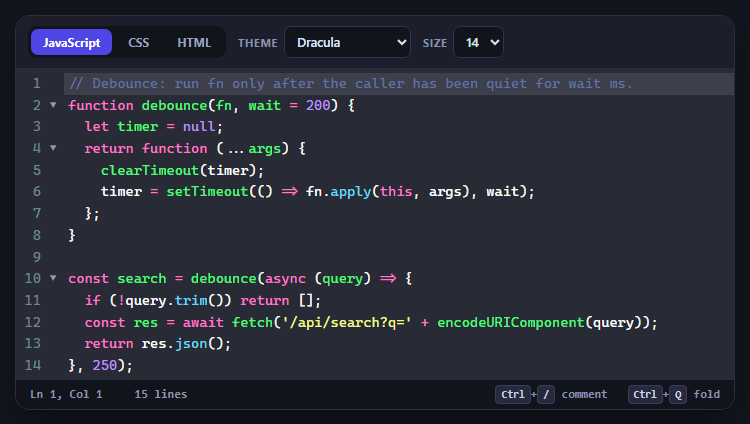
CodeMirror Code Editor with Line Numbers, Folding and Themes

Marked + DOMPurify Live Markdown Preview
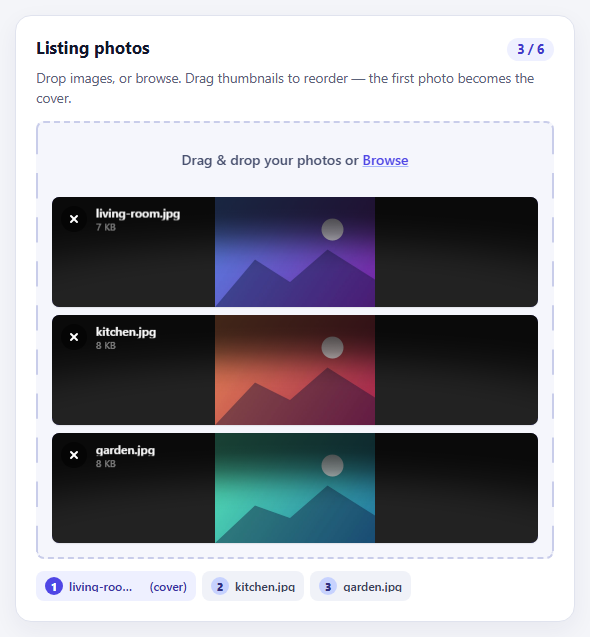
FilePond Image Upload with Preview and Reorder

Cropper.js Aspect-Ratio Presets for Social Posts
Discrete Snap-Stop Slider — HTML CSS JS Snippet
Discrete Snap-Stop Slider · Forms · Plain HTML, CSS & JS · Live preview
Copy & paste
Source Code
<div class="dss-wrap">
  <label class="dss-label">Shipping speed</label>
  <div class="dss-track-wrap">
    <div class="dss-track">
      <div class="dss-fill" id="dssFill"></div>
      <button class="dss-stop" data-i="0" style="left:0%"></button>
      <button class="dss-stop" data-i="1" style="left:33.33%"></button>
      <button class="dss-stop" data-i="2" style="left:66.66%"></button>
      <button class="dss-stop" data-i="3" style="left:100%"></button>
      <div class="dss-thumb" id="dssThumb" tabindex="0" role="slider" aria-valuemin="0" aria-valuemax="3" aria-valuenow="0"></div>
    </div>
  </div>
  <div class="dss-ticks" id="dssTicks"></div>
</div>*{box-sizing:border-box;margin:0;padding:0}
body{font-family:system-ui,-apple-system,sans-serif;background:#f6f7f9;min-height:100vh;display:flex;align-items:center;justify-content:center;padding:24px}
.dss-wrap{width:100%;max-width:380px}
.dss-label{display:block;font-size:12.5px;font-weight:700;color:#4b5563;margin-bottom:18px}
.dss-track-wrap{padding:0 2px}
.dss-track{position:relative;height:5px;border-radius:6px;background:#e5e7eb}
.dss-fill{position:absolute;top:0;left:0;height:100%;border-radius:6px;background:#6366f1;width:0%;transition:width .25s cubic-bezier(.4,0,.2,1)}
.dss-stop{position:absolute;top:50%;width:9px;height:9px;border-radius:50%;background:#d1d5db;border:2px solid #f6f7f9;transform:translate(-50%,-50%);cursor:pointer;z-index:1}
.dss-thumb{position:absolute;top:50%;left:0%;width:20px;height:20px;border-radius:50%;background:#fff;border:3px solid #6366f1;box-shadow:0 2px 8px rgba(15,23,42,.2);transform:translate(-50%,-50%);cursor:grab;transition:left .25s cubic-bezier(.4,0,.2,1);z-index:2}
.dss-thumb:active{cursor:grabbing}
.dss-thumb:focus-visible{outline:2px solid #6366f1;outline-offset:3px}
.dss-ticks{display:flex;justify-content:space-between;margin-top:12px}
.dss-ticks span{font-size:11px;font-weight:600;color:#9ca3af;transition:color .2s}
.dss-ticks span.active{color:#6366f1}var LABELS = ['Standard', 'Express', 'Overnight', 'Same-Day'];
var track = document.querySelector('.dss-track');
var thumb = document.getElementById('dssThumb');
var fill = document.getElementById('dssFill');
var ticksWrap = document.getElementById('dssTicks');
var count = LABELS.length;
var current = 0;
LABELS.forEach(function (label, i) {
var t = document.createElement('span');
t.textContent = label;
ticksWrap.appendChild(t);
});
var tickEls = document.querySelectorAll('.dss-ticks span');
function render() {
var pct = (current / (count - 1)) * 100;
thumb.style.left = pct + '%';
fill.style.width = pct + '%';
thumb.setAttribute('aria-valuenow', current);
thumb.setAttribute('aria-valuetext', LABELS[current]);
tickEls.forEach(function (t, i) { t.classList.toggle('active', i === current); });
}
function setIndex(i) {
current = Math.max(0, Math.min(count - 1, i));
render();
}
document.querySelectorAll('.dss-stop').forEach(function (stop) {
stop.addEventListener('click', function () { setIndex(parseInt(stop.dataset.i, 10)); });
});
tickEls.forEach(function (t, i) {
t.style.cursor = 'pointer';
t.addEventListener('click', function () { setIndex(i); });
});
function pctFromEvent(clientX) {
var rect = track.getBoundingClientRect();
var x = Math.max(0, Math.min(rect.width, clientX - rect.left));
return x / rect.width;
}
var dragging = false;
function onMove(e) {
if (!dragging) return;
var clientX = e.touches ? e.touches[0].clientX : e.clientX;
var pct = pctFromEvent(clientX);
var nearest = Math.round(pct * (count - 1));
if (nearest !== current) setIndex(nearest);
}
function startDrag(e) {
dragging = true;
thumb.style.transition = 'none';
onMove(e);
}
function endDrag() {
if (!dragging) return;
dragging = false;
thumb.style.transition = '';
render();
}
thumb.addEventListener('pointerdown', startDrag);
window.addEventListener('pointermove', onMove);
window.addEventListener('pointerup', endDrag);
thumb.addEventListener('touchstart', startDrag, { passive: true });
window.addEventListener('touchmove', onMove, { passive: true });
window.addEventListener('touchend', endDrag);
thumb.addEventListener('keydown', function (e) {
if (e.key === 'ArrowRight' || e.key === 'ArrowUp') { setIndex(current + 1); e.preventDefault(); }
else if (e.key === 'ArrowLeft' || e.key === 'ArrowDown') { setIndex(current - 1); e.preventDefault(); }
else if (e.key === 'Home') { setIndex(0); e.preventDefault(); }
else if (e.key === 'End') { setIndex(count - 1); e.preventDefault(); }
});
render();Extend with AI
Take This Snippet Further With AI
The AI prompt for this one is for Patreon supporters ($3 a month, 7 days free), along with a site with no ads. Supporters enter the passcode once and it is remembered in this browser.
What's included
Features
About this UI Snippet
Discrete Snap-Stop Slider — An Index, Not a Continuous Value

A price-range slider outputs any number between its min and max. This one is a completely different kind of control: it holds an *index* into a fixed list of labeled options — Standard, Express, Overnight, Same-Day — and can only ever land on exactly one of those four positions. There is no such thing as "index 1.5" here; every interaction, whatever triggers it, ends by calling setIndex() with a whole number.
Percentage is derived from the index, never the reverse
render() computes the thumb's visual position with one line: pct = (current / (count - 1)) * 100. Dragging works the opposite direction — it converts a raw pointer position into a percentage, then *rounds* that percentage into the nearest whole index with Math.round(pct * (count - 1)), and only that rounded index is ever written to current. The thumb visually eases to the exact stop position via a CSS transition on left, but the underlying state was never anything other than a clean integer.
Every input path converges on one function
Clicking a stop dot, clicking a text label, dragging the thumb, and pressing an arrow key are four completely different gestures, but every one of them ends by calling setIndex(i) — which is the only place that clamps the value into range and re-renders. That's what guarantees the slider can never visually or logically land between two stops, no matter which input method was used.
Step by step
How to Use
- 1Paste HTML, CSS, and JSA 4-stop slider appears, set to "Standard" with the label highlighted below it.
- 2Drag the thumbIt follows your cursor smoothly, but always eases to and settles on the nearest labeled stop — never in between.
- 3Click a dot or labelJump straight to that exact stop with a smooth transition.
- 4Use arrow keysFocus the thumb and press Left/Right to move one stop at a time; Home/End jump to the first or last.
- 5Add a fifth tierAdd one label to LABELS and one .dss-stop button positioned at its new percentage — the math adjusts automatically.
Real-world uses
Common Use Cases
Got questions?
Frequently Asked Questions
Add one string to the LABELS array and one matching .dss-stop button in the HTML, positioned at its new even percentage (100 / (new count - 1) per step) — count updates automatically from LABELS.length.
Yes — give each .dss-stop button a custom left percentage instead of even spacing, and replace the render() percentage formula with a lookup table mapping each index to its actual custom percentage.
Rounding live (during the drag, not just at the end) is what makes the fill bar and any live label always show the stop you're about to land on, giving immediate feedback rather than a jarring correction only at release.
LABELS[current] gives the selected label at any time; hook a callback or custom event dispatch inside setIndex if you need to react to changes elsewhere in a real application.
Yes — the thumb carries role="slider" with aria-valuemin/max/now plus aria-valuetext for the human-readable label, and is fully operable via Left/Right/Up/Down/Home/End without a mouse.