

Quill Rich Text Editor with Custom Toolbar and Character Limit

CodeMirror JSON Editor with Validation Gutter
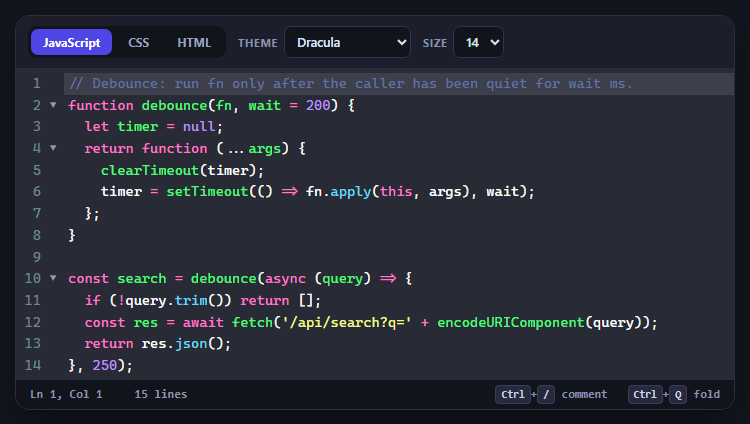
CodeMirror Code Editor with Line Numbers, Folding and Themes

Marked + DOMPurify Live Markdown Preview
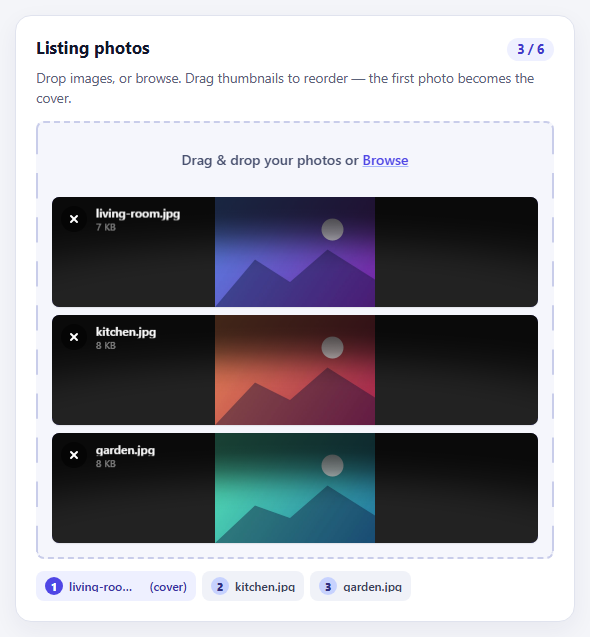
FilePond Image Upload with Preview and Reorder

Cropper.js Aspect-Ratio Presets for Social Posts
Multi-File Upload Queue — Concurrency-Limited Upload Loader
Multi-File Upload Queue · Forms · Plain HTML, CSS & JS · Live preview
Copy & paste
Source Code
<div class="fq-card">
  <div class="fq-summary">
    <div class="fq-summary-row">
      <span class="fq-summary-label" id="fqLabel">Uploading 6 files…</span>
      <span class="fq-summary-pct" id="fqPct">0%</span>
    </div>
    <div class="fq-summary-track"><div class="fq-summary-fill" id="fqFill"></div></div>
    <div class="fq-summary-meta" id="fqMeta">2 active · 1 queued · 3 waiting</div>
  </div>
  <ul class="fq-list" id="fqList"></ul>
  <button type="button" class="fq-restart" id="fqRestart">↻ Run queue again</button>
</div>*{box-sizing:border-box;margin:0;padding:0}
body{font-family:system-ui,-apple-system,sans-serif;background:#0b0f1a;min-height:100vh;display:flex;align-items:center;justify-content:center;padding:24px}
.fq-card{width:100%;max-width:420px;background:#121729;border:1px solid #232a41;border-radius:16px;padding:20px;box-shadow:0 18px 44px rgba(0,0,0,.4)}
.fq-summary{padding-bottom:14px;margin-bottom:12px;border-bottom:1px solid #1f2538}
.fq-summary-row{display:flex;justify-content:space-between;align-items:baseline;margin-bottom:8px}
.fq-summary-label{font-size:13px;font-weight:700;color:#fff}
.fq-summary-pct{font-size:13px;font-weight:800;color:#818cf8;font-variant-numeric:tabular-nums}
.fq-summary-track{height:6px;background:#1c2338;border-radius:4px;overflow:hidden}
.fq-summary-fill{height:100%;width:0%;background:linear-gradient(90deg,#6366f1,#22d3ee);border-radius:4px;transition:width .25s ease}
.fq-summary-meta{margin-top:7px;font-size:11px;color:#6b7591}
.fq-list{list-style:none;display:flex;flex-direction:column;gap:8px;max-height:320px;overflow-y:auto}
.fq-row{display:flex;align-items:center;gap:10px;padding:9px 10px;border-radius:10px;background:#161b2c;border:1px solid #1f2538;opacity:.55;transition:opacity .25s}
.fq-row.is-active,.fq-row.is-done,.fq-row.is-error{opacity:1}
.fq-icon{width:30px;height:30px;border-radius:8px;flex-shrink:0;display:flex;align-items:center;justify-content:center;font-size:13px;background:#1f2538}
.fq-body{flex:1;min-width:0}
.fq-name{font-size:12.5px;font-weight:700;color:#dbe0f0;white-space:nowrap;overflow:hidden;text-overflow:ellipsis}
.fq-sub{font-size:10.5px;color:#6b7591;margin-top:2px}
.fq-track{height:3px;background:#1f2538;border-radius:2px;margin-top:6px;overflow:hidden}
.fq-fill{height:100%;width:0%;background:#6366f1;border-radius:2px}
.fq-row.is-done .fq-fill{background:#22c55e}
.fq-row.is-error .fq-fill{background:#f87171}
.fq-status{font-size:10.5px;font-weight:800;flex-shrink:0;text-transform:uppercase;letter-spacing:.03em}
.fq-row.is-queued .fq-status{color:#6b7591}
.fq-row.is-active .fq-status{color:#818cf8}
.fq-row.is-done .fq-status{color:#22c55e}
.fq-row.is-error .fq-status{color:#f87171}
.fq-retry{margin-left:6px;font-size:10.5px;font-weight:800;color:#fff;background:#3730a3;border:none;border-radius:6px;padding:4px 8px;cursor:pointer;font-family:inherit}
.fq-retry:hover{background:#4338ca}
.fq-restart{display:none;margin-top:14px;width:100%;padding:9px;background:#1c2338;border:1px solid #2b3350;color:#c3cadf;border-radius:10px;font-size:12.5px;font-weight:700;cursor:pointer;font-family:inherit}
.fq-restart.show{display:block}
.fq-restart:hover{background:#242c47}var FILES = [
{ name: 'brand-guidelines.pdf', size: '4.1 MB' },
{ name: 'hero-banner.png', size: '2.8 MB' },
{ name: 'product-shots.zip', size: '18.3 MB' },
{ name: 'presentation-deck.pptx', size: '9.6 MB' },
{ name: 'invoice-q3.pdf', size: '312 KB' },
{ name: 'demo-recording.mp4', size: '54.2 MB' },
];
var MAX_CONCURRENT = 2;
var ERROR_INDEX = 2; // "product-shots.zip" fails once, then succeeds on retry
var list = document.getElementById('fqList');
var fill = document.getElementById('fqFill');
var pct = document.getElementById('fqPct');
var label = document.getElementById('fqLabel');
var meta = document.getElementById('fqMeta');
var restartBtn = document.getElementById('fqRestart');
var state = []; // { status: 'waiting'|'queued'|'active'|'done'|'error', progress: 0-100, timer }
function iconFor(name) {
var ext = name.split('.').pop();
if (ext === 'pdf') return '📄';
if (ext === 'png' || ext === 'jpg') return '🖼️';
if (ext === 'zip') return '🗜️';
if (ext === 'pptx') return '📊';
if (ext === 'mp4') return '🎬';
return '📁';
}
function buildList() {
list.innerHTML = '';
state = FILES.map(function (f, i) {
var li = document.createElement('li');
li.className = 'fq-row is-waiting';
li.id = 'fq-row-' + i;
li.innerHTML =
'<div class="fq-icon">' + iconFor(f.name) + '</div>' +
'<div class="fq-body">' +
'<div class="fq-name">' + f.name + '</div>' +
'<div class="fq-sub">' + f.size + '</div>' +
'<div class="fq-track"><div class="fq-fill" id="fq-fill-' + i + '"></div></div>' +
'</div>' +
'<span class="fq-status" id="fq-status-' + i + '">Waiting</span>';
list.appendChild(li);
return { status: 'waiting', progress: 0, timer: null };
});
}
function activeCount() {
return state.filter(function (s) { return s.status === 'active'; }).length;
}
function updateSummary() {
var doneCount = state.filter(function (s) { return s.status === 'done'; }).length;
var errorCount = state.filter(function (s) { return s.status === 'error'; }).length;
var active = activeCount();
var waiting = state.filter(function (s) { return s.status === 'waiting'; }).length;
var avg = state.reduce(function (sum, s) { return sum + (s.status === 'error' ? 0 : s.progress); }, 0) / state.length;
fill.style.width = avg.toFixed(0) + '%';
pct.textContent = avg.toFixed(0) + '%';
meta.textContent = active + ' active · ' + waiting + ' waiting · ' + doneCount + ' done' + (errorCount ? ' · ' + errorCount + ' failed' : '');
if (doneCount + errorCount === state.length) {
if (errorCount) {
label.textContent = 'Finished with ' + errorCount + ' error' + (errorCount > 1 ? 's' : '');
} else {
label.textContent = 'All ' + state.length + ' files uploaded';
}
restartBtn.classList.add('show');
} else {
label.textContent = 'Uploading ' + state.length + ' files…';
}
}
function renderRow(i) {
var s = state[i];
var row = document.getElementById('fq-row-' + i);
var statusEl = document.getElementById('fq-status-' + i);
var fillEl = document.getElementById('fq-fill-' + i);
row.className = 'fq-row is-' + s.status;
fillEl.style.width = s.progress.toFixed(0) + '%';
if (s.status === 'waiting') statusEl.textContent = 'Waiting';
else if (s.status === 'active') statusEl.textContent = s.progress.toFixed(0) + '%';
else if (s.status === 'done') statusEl.textContent = '✓ Done';
else if (s.status === 'error') {
statusEl.innerHTML = 'Failed <button type="button" class="fq-retry" onclick="retryFile(' + i + ')">Retry</button>';
}
}
function startFile(i) {
var s = state[i];
s.status = 'active';
s.progress = 0;
renderRow(i);
var speed = Math.random() * 6 + 3;
s.timer = setInterval(function () {
// The designated file fails partway through the first time only.
if (i === ERROR_INDEX && !s.hasFailedOnce && s.progress > 40) {
clearInterval(s.timer);
s.status = 'error';
s.hasFailedOnce = true;
renderRow(i);
updateSummary();
fillQueue();
return;
}
s.progress = Math.min(100, s.progress + speed * (Math.random() * 0.6 + 0.7));
renderRow(i);
if (s.progress >= 100) {
clearInterval(s.timer);
s.status = 'done';
renderRow(i);
updateSummary();
fillQueue();
} else {
updateSummary();
}
}, 220);
}
// Only MAX_CONCURRENT files upload at once; the rest sit "waiting" until a
// slot frees up, like a real download/upload manager's queue.
function fillQueue() {
while (activeCount() < MAX_CONCURRENT) {
var nextIndex = state.findIndex(function (s) { return s.status === 'waiting'; });
if (nextIndex === -1) break;
startFile(nextIndex);
}
}
function retryFile(i) {
startFile(i);
updateSummary();
}
window.retryFile = retryFile;
function runQueue() {
buildList();
restartBtn.classList.remove('show');
updateSummary();
fillQueue();
}
restartBtn.addEventListener('click', runQueue);
runQueue();Extend with AI
Take This Snippet Further With AI
The AI prompt for this one is for Patreon supporters ($3 a month), along with a site with no ads. Supporters enter the passcode once and it is remembered in this browser.
What's included
Features
About this UI Snippet
Multi-File Upload Queue — Limited-Concurrency Uploads with Retry

Real upload managers rarely fire every file at once — bandwidth and browser connection limits mean only a handful upload concurrently while the rest wait their turn. This snippet models that honestly: six files queue up, only two upload at a time, each running file advances on its own randomised interval so they finish at different moments, one file genuinely fails partway through with a retry action, and a live aggregate bar and status line summarise the whole queue — all in plain HTML, CSS, and vanilla JavaScript, no drag-and-drop chrome, focused purely on the queue mechanics.
A concurrency-limited queue, not a free-for-all
fillQueue() is the core of the snippet: it counts how many files are currently active and starts new ones from the waiting pool only until MAX_CONCURRENT (2) is reached. Every time a file finishes — successfully or with an error — fillQueue() runs again, pulling the next waiting file into an open slot. This is the same limited-concurrency pattern real upload clients use to avoid saturating a connection, and it's a meaningfully different mechanic from a simple "start everything simultaneously" uploader.
Independent, realistically staggered progress
Each active file gets its own setInterval with a randomised speed, so two files running side by side visibly finish at different times — one might complete in three seconds, another in eight. Nothing is synchronised or faked to look tidy; the raw randomness is what makes the queue feel like real network activity rather than a scripted animation.
A genuine failure and retry
One file (ERROR_INDEX) is scripted to fail once it passes 40% progress on its first attempt, switching to a red error row with an inline Retry button. Clicking Retry calls startFile again for that index, which restarts its progress from zero and re-enters the active pool — this time it's allowed to succeed, demonstrating a real state transition from error back to active rather than a decorative error icon that never resolves.
A live, honest aggregate
The top summary bar isn't a rough estimate — updateSummary() recomputes the true average of every file's current progress (treating a failed file as 0% until it's retried) on every tick, plus a live breakdown of how many files are active, waiting, done, or failed. This mirrors exactly what a user needs to know at a glance: how far along is the whole batch, and is anything stuck.
Wiring it to a real backend
Replace startFile's simulated interval with a real XMLHttpRequest (or fetch with a readable stream) per file, updating s.progress from upload.onprogress's loaded/total, and call fillQueue() from that request's load/error handlers instead of the simulated completion. The concurrency-limiting, retry, and summary logic all stay exactly the same. Pair it with the drag-and-drop upload progress pattern for the initial file-picking step, or a loading overlay while the queue completes.
Step by step
How to Use
- 1Paste HTML, CSS, and JSSix files render, two begin uploading immediately, the rest sit "Waiting".
- 2Watch the queue advanceAs each active file finishes, the next waiting file automatically starts.
- 3See the scripted failureOne file fails partway through and shows a Retry button.
- 4Click RetryThat file restarts from zero and succeeds on its second attempt.
- 5Watch the summary barThe top bar and meta line track the true live average and counts.
- 6Run it againOnce every file settles, click "Run queue again" to reset and replay.
Real-world uses
Common Use Cases
fillQueue() pulling the next waiting file the moment a slot opens.Got questions?
Frequently Asked Questions
fillQueue() counts files currently in the active status and starts more from the waiting pool only until MAX_CONCURRENT is reached. It's called again every time a file finishes or errors, so a freed slot is immediately backfilled from the queue — the same mechanic real upload managers use to avoid overwhelming a connection.
Each active file runs its own setInterval with a randomised per-tick speed, so two files started at the same moment naturally diverge — one may finish well before the other. Nothing is synchronised on purpose; the unscripted variance is what makes the queue read as real network activity.
One file is scripted to fail once past 40% progress on its first attempt, switching to an error row with a Retry button. Clicking Retry calls startFile again for that index, resetting its progress to zero and re-entering the active pool exactly like a fresh upload — this time it's allowed to complete, so the failure-to-success transition is real, not decorative.
It's a real average. updateSummary() sums every file's current progress (a failed file counts as 0% until retried) and divides by the total file count on every tick, so the top bar and percentage always reflect the true, live state of every row — not a smoothed or faked approximation.
Replace startFile's setInterval with a real XMLHttpRequest per file: update s.progress from xhr.upload.onprogress's loaded/total, and call fillQueue() from the request's load and error handlers instead of the simulated completion. Keep MAX_CONCURRENT, the retry button, and updateSummary unchanged — they operate purely on the state array regardless of what drives it.