

Minesweeper Game with 20 Levels, No-Guess Boards & Hints
Minesweeper Puzzle Game · Games · Plain HTML, CSS & JS · Live preview
For supporters
Source Code
Want the source code?
Play the game for free. Become a WebDevPuneet supporter to unlock the complete HTML, CSS and JavaScript source code, the exports (HTML, React, Vue, Angular, Tailwind) and Fork.
Extend with AI
Take This Snippet Further With AI
The AI prompt for this one is for Patreon supporters ($3 a month), along with a site with no ads. Supporters enter the passcode once and it is remembered in this browser.
What's included
Features
About this UI Snippet
Minesweeper — 20 Levels, Boards Solvable Without Guessing, Hints That Explain, Chording and a Daily Board
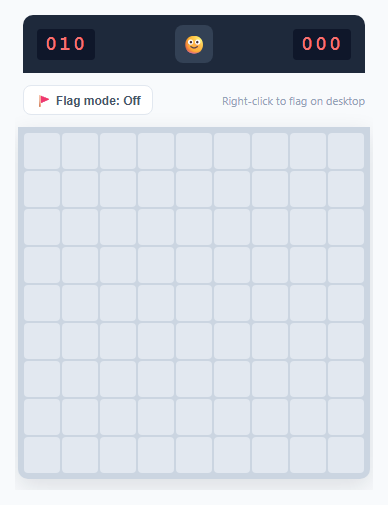
Minesweeper is a logic puzzle: numbers tell you how many mines touch a cell, and you clear the field using deduction alone. This version is a complete game rather than a demo. It has 20 levels in four tiers, a Daily Board with a streak, boards that can always be solved without guessing, hints that explain the deduction in words, chording, extra lives on the easier levels, stars and best times. It is plain HTML, CSS and JavaScript with no libraries, images or audio files.
Boards that never force a guess
The classic frustration in Minesweeper is a 50/50 guess at the end of a long game. generateBoard() removes it. It picks a start cell, places the mines away from that cell and its neighbours, and then runs the logic solver on the finished board. Only boards that the solver can clear completely from the opening are kept, otherwise another seed is tried. The opening is revealed when the level starts, so a first-click guess is not needed either. A seeded random generator (mulberry32) means a level is the same board for every player.
The solver is the hint system too
findSteps() applies two rules to every revealed number. If a number already has all its mines marked, its other hidden neighbours are safe. If it has exactly as many hidden neighbours as mines left, they are all mines. When neither applies, the subset rule compares two numbers: if the hidden neighbours of one number are all neighbours of another, subtracting them settles the difference. The Hint button runs the same function on your current board and explains the result in words, for example "Every hidden cell next to the 1 at C3 is also next to the 2 at D3, and they need the same number of mines, so E3 is safe." It highlights the clue numbers in amber and the target cell in green (safe) or red (mine). If you have placed a wrong flag, the hint points that out first.
Controls for mouse, keyboard and touch
Left-click reveals, right-click flags, and clicking a revealed number does a chord: if the number of flags around it matches, every other neighbour is revealed at once, which is the fastest way to play. A press-and-hold flags on a touch screen, and a Flag mode button is there too. The keyboard works as well: arrow keys move a cursor, Space or Enter reveals, F flags, C chords, H hints and R restarts.
Lives, stars and the daily board
The first levels give three lives and later ones two or one: stepping on a mine costs a life, marks that mine and lets you carry on. Winning earns one star, a second star for a clean run with no mines hit and no hints, and a third for finishing under the par time. Clearing a level unlocks the next, and best times are saved. The Daily Board is a seeded 16 by 16 board with 40 mines, the same for everyone, and clearing it on consecutive days builds a streak.
Feel and scaling
Flood fills ripple outwards from the clicked cell, explosions shake the panel and flash the cell, a wave sweeps across the board when you win, and the sounds (clicks, flags, an explosion made of filtered noise and a win jingle) come from a Web Audio synth. Flags and mines are drawn as inline SVG, so they look the same everywhere. Progress, best times and the streak are saved to localStorage inside try/catch, and the whole game scales to short preview areas, from an 8 by 8 board up to 26 by 15.
Step by step
How to Use
- 1Pick a level or the Daily BoardThe menu shows 20 levels in four tiers, from 8 by 8 with three lives to 26 by 15 with one life. Level 1 is open at first and each cleared level unlocks the next. The gold card starts the Daily Board, the same for everyone.
- 2Start from the openingEvery board starts with an opening already revealed, so you never have to guess. Read the numbers: a number is how many of the 8 cells around it contain a mine.
- 3Reveal and flagClick a cell to reveal it. Right-click it, or press and hold on a touch screen, to flag a suspected mine. The Flag mode button (or F) switches the click to flagging. The counter shows the mines left minus your flags.
- 4Chord to go fasterClick a revealed number when you have flagged exactly that many mines around it, and every other neighbour opens at once. A wrong flag will make you hit a mine, so be sure.
- 5Ask for a hint when stuckThe Hint button (H) finds a deduction that is certain and explains it, highlighting the numbers it used and the cell it settles. You get three hints per game and using one costs the clean-run star.
- 6Earn starsOne star for clearing the board, a second for no mines hit and no hints, a third for finishing under the par time. A mine costs a life, and on the later levels one mine ends the game.
Real-world uses
Common Use Cases
Got questions?
Frequently Asked Questions
generateBoard() places mines at random away from a chosen start cell, then plays the whole board with the solver. isLogicSolvable() reveals the opening, then repeatedly applies findSteps(): flag the certain mines, reveal the certain safe cells and repeat. If every safe cell gets revealed this way, the board is kept. If the solver gets stuck, the board is thrown away and the next seed is tried, up to 400 times.
They run the same solver on your current board. Mines you have flagged correctly count as known, wrong flags are ignored and pointed out first. The first certain step is explained in a sentence, the clue numbers are highlighted in amber and the target cell in green (safe) or red (mine). A hint costs the clean-run star, and you get three per game.
Clicking a revealed number whose count equals the number of flags around it. The game reveals every other hidden neighbour at once. It is much faster than clicking each cell, but if one of your flags is wrong you will hit a mine, which is why the Flag mode and hints exist.
The early levels have three lives, then two, then one. A mine costs a life, shows the mine and lets you continue. A level gives one star for clearing it, a second if you hit no mine and used no hint, and a third if you finish under the par time (a function of the board size and the number of mines). The next level unlocks when the previous one has a star.
Edit the LEVELS array: each row is columns, rows, mines and lives. Keep mines below about 22 percent of the cells, because very dense boards are rarely solvable by logic alone and the generator then needs many attempts. The cell size adapts to the board, and the menu shows five levels per tier.
Yes. All localStorage access is in try/catch, so a blocked storage only means progress is not saved, and every sound call is wrapped. Press and hold flags on a touch screen, and Flag mode is a button. On narrow screens the layout stacks and the page scrolls.