


Matter.js Hill Climb Car Game — Boost, Coins and Flips
Matter.js Hill Climb Car Game · Games · Plain HTML, CSS & JS · Live preview
For supporters
Source Code
Want the source code?
Play the game for free. Become a WebDevPuneet supporter to unlock the complete HTML, CSS and JavaScript source code, the exports (HTML, React, Vue, Angular, Tailwind) and Fork.
Extend with AI
Take This Snippet Further With AI
The AI prompt for this one is for Patreon supporters ($3 a month, 7 days free), along with a site with no ads. Supporters enter the passcode once and it is remembered in this browser.
What's included
Features
About this UI Snippet
Matter.js Hill Climb Car — Suspension, Boost, Coins, Flip Tricks and a Parallax World
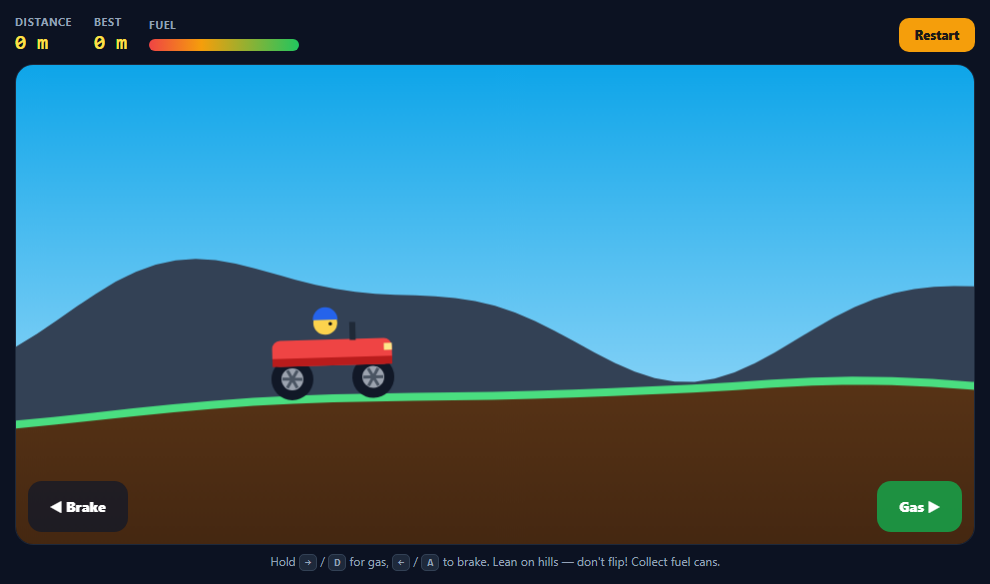
Hill Climb Racing's charm is pure physics: a floppy little car, bumpy hills and a driver whose head must never touch the ground. This snippet rebuilds that loop with Matter.js and turns it into a complete game with a start screen, a 500 m summit to reach, coins, a nitro boost, flip bonuses, dust and flame particles, screen shake, a parallax landscape and optional engine sound. Everything is plain JavaScript on one canvas.
The car: three bodies and some springs
The chassis is a chamfered rectangle; each wheel is a circle joined to it by two constraints, a soft short spring from above (the suspension) and a diagonal one that stops the wheel sliding along the body. A small head body sits on a stiff neck. All parts share a negative collision group from Body.nextGroup(true), so wheels never collide with their own chassis. The car is drawn by hand each frame from the bodies' positions and angles.
Driving by spinning wheels, and boost
The engine never pushes the car. While a pedal is held, the wheels' angular velocity is eased toward a maximum with Body.setAngularVelocity, and wheel friction turns that spin into motion. Boost raises the target spin by 70% and adds a forward force along the chassis. It drains its own meter in about three seconds and refills slowly; collecting a coin gives a little back. Flame particles stream from the exhaust while it burns.
Air control and flip bonuses
When neither wheel touches the terrain (Query.collides), the pedals tilt the chassis instead of driving. While airborne, the game adds up the chassis rotation each step; if you land upright after turning roughly a full revolution, you earn 100 points per flip with a "Front flip" or "Back flip" popup. Landing upside down just counts as a crash.
Coins, fuel and the finish
Coin arcs follow the hills, and the middle of each arc floats high enough to reward a jump. Coins are plain objects checked by distance, so there are no extra physics bodies; the fuel cans are static sensors. Fuel drains while a pedal is held, a can refills it, and the run ends when your head hits the ground, you are upside down for 1.5 seconds, you stop with an empty tank, or you pass 500 m and reach the checkered flag. The score is distance plus 10 per coin plus flip bonuses, and your best is saved in localStorage.
Terrain without poly-decomp
Hills are summed sine waves whose amplitude grows with distance. Instead of one huge concave body, the ground is 520 thin static rectangles, each rotated to the slope between two sample points. The visible ground is drawn separately as a filled path with a dark lip and a grass stroke.
Camera, parallax and feel
With hasBounds: true, the renderer only draws what is inside render.bounds. Each frame the bounds ease toward the car, leading slightly in the direction of travel, and crashes add a decaying shake. The sun, clouds and two hill layers are painted last with destination-over at different scroll speeds, so they sit behind the world and give depth.
Sound and controls
Sound is off until you press the button, which is also what lets browsers start audio. An oscillator through a low-pass filter follows the car's speed and throttle, and short beeps mark coins, fuel, flips and crashes. Keyboard, on-screen touch pedals and a restart key are all supported.
Step by step
How to Use
- 1Press Start drivingThe start card lists the goal: reach the 500 m summit. Press the button, Enter or → to begin.
- 2Gas, brake and boostHold → or D for gas, ← or A to brake and reverse, and ↑, W or Space for nitro. On a phone use the three on-screen pedals.
- 3Lean in the airWith both wheels off the ground the pedals tilt the car. Rotate a full turn and land upright for +100 flip points.
- 4Collect coins and fuelCoins add 10 points each and a little boost. Yellow cans refill the tank, so plan your throttle between them.
- 5Watch the progress barThe bar along the top of the stage shows how far you are from the checkered flag at 500 m.
- 6Beat your bestPress R to restart at any time. Your best score is remembered, and the Sound button adds engine noise and effects.
Real-world uses
Common Use Cases
Got questions?
Frequently Asked Questions
Make a chassis body and two circle wheels, connect each wheel with Constraints (a soft spring for suspension plus one to hold its position) and put all parts in one negative collision group. Drive by easing the wheels' angular velocity toward a target.
While both wheels are off the terrain, the game adds the change in chassis angle each step into airSpin. When a wheel touches down, if the car is upright and the total passed about 5.4 radians (almost a full turn), it awards 100 points per revolution and shows a popup. The sign of airSpin decides between front and back flip.
While the boost key is held and the meter has charge, the target wheel spin is multiplied by 1.7 and Body.applyForce pushes the chassis along its heading. The meter drains a little each step and recharges when you release, so it works as a short burst you spend on hills.
Create the renderer with hasBounds: true and update render.bounds.min and max every frame in beforeRender to centre on the body. Easing toward the target keeps it smooth, and adding a little velocity-based lead shows more of what is ahead.
Browsers only allow audio to start after a user gesture, so the Sound button creates the AudioContext when pressed. An oscillator through a low-pass filter plays the engine, and its pitch follows speed and throttle.