
Mortgage Payment Breakdown — Free PITI Calculator with Real Amortization
Mortgage Payment Breakdown · Charts · Plain HTML, CSS & JS · Live preview
Copy & paste
Source Code
<div class="mpb-card">
  <div class="mpb-head">
    <h3>Monthly payment breakdown</h3>
    <p>Adjust the inputs — the donut and totals recalculate with the real amortization formula.</p>
  </div>

  <div class="mpb-grid">
    <div class="mpb-inputs">
      <label class="mpb-field">
        <span>Home price</span>
        <input type="number" id="mpbPrice" value="420000" min="0" step="1000">
      </label>
      <label class="mpb-field">
        <span>Down payment</span>
        <input type="number" id="mpbDown" value="84000" min="0" step="1000">
      </label>
      <label class="mpb-field">
        <span>Interest rate (APR %)</span>
        <input type="number" id="mpbRate" value="6.5" min="0" step="0.05">
      </label>
      <label class="mpb-field">
        <span>Term (years)</span>
        <select id="mpbTerm">
          <option value="15">15</option>
          <option value="30" selected>30</option>
        </select>
      </label>
      <label class="mpb-field">
        <span>Annual property tax</span>
        <input type="number" id="mpbTax" value="5200" min="0" step="50">
      </label>
      <label class="mpb-field">
        <span>Annual insurance</span>
        <input type="number" id="mpbIns" value="1400" min="0" step="50">
      </label>
    </div>

    <div class="mpb-result">
      <svg class="mpb-donut" viewBox="0 0 120 120" aria-hidden="true">
        <circle class="mpb-track" cx="60" cy="60" r="50" />
        <circle class="mpb-seg" id="mpbSegPrincipal" cx="60" cy="60" r="50" />
        <circle class="mpb-seg" id="mpbSegInterest" cx="60" cy="60" r="50" />
        <circle class="mpb-seg" id="mpbSegTax" cx="60" cy="60" r="50" />
        <circle class="mpb-seg" id="mpbSegIns" cx="60" cy="60" r="50" />
      </svg>
      <div class="mpb-total" id="mpbTotal">$0</div>
      <div class="mpb-total-label">per month</div>

      <ul class="mpb-legend" id="mpbLegend"></ul>
    </div>
  </div>
</div>*{box-sizing:border-box;margin:0;padding:0}
body{font-family:system-ui,-apple-system,sans-serif;background:#0b0c14;min-height:100vh;display:flex;align-items:center;justify-content:center;padding:24px}
.mpb-card{background:#12141f;border:1px solid #232a3d;border-radius:18px;padding:26px;width:100%;max-width:640px;color:#e6e8f5}
.mpb-head h3{font-size:17px;font-weight:800;margin-bottom:6px}
.mpb-head p{font-size:12.5px;color:#8b93b0;margin-bottom:22px}
.mpb-grid{display:grid;grid-template-columns:1fr 220px;gap:24px}
@media (max-width:560px){.mpb-grid{grid-template-columns:1fr}}
.mpb-inputs{display:flex;flex-direction:column;gap:12px}
.mpb-field{display:flex;flex-direction:column;gap:5px;font-size:11.5px;color:#9aa0c0}
.mpb-field input,.mpb-field select{background:#0e1018;border:1px solid #232a3d;border-radius:8px;padding:9px 10px;color:#fff;font-size:13.5px;outline:none}
.mpb-field input:focus,.mpb-field select:focus{border-color:#60a5fa}
.mpb-result{display:flex;flex-direction:column;align-items:center;text-align:center}
.mpb-donut{width:130px;height:130px;transform:rotate(-90deg)}
.mpb-track{fill:none;stroke:#1e2230;stroke-width:16}
.mpb-seg{fill:none;stroke-width:16;stroke-linecap:butt;transition:stroke-dasharray .4s ease,stroke-dashoffset .4s ease}
.mpb-total{font-size:26px;font-weight:800;margin-top:-88px}
.mpb-total-label{font-size:11px;color:#8b93b0;margin-bottom:14px}
.mpb-legend{list-style:none;text-align:left;width:100%;display:flex;flex-direction:column;gap:6px;font-size:11.5px}
.mpb-legend li{display:flex;justify-content:space-between;align-items:center;gap:8px}
.mpb-dot{width:8px;height:8px;border-radius:50%;display:inline-block;margin-right:6px;flex-shrink:0}
.mpb-legend-label{display:flex;align-items:center;color:#9aa0c0}
.mpb-legend-value{font-weight:700;color:#e6e8f5}var priceEl = document.getElementById('mpbPrice');
var downEl = document.getElementById('mpbDown');
var rateEl = document.getElementById('mpbRate');
var termEl = document.getElementById('mpbTerm');
var taxEl = document.getElementById('mpbTax');
var insEl = document.getElementById('mpbIns');
var totalEl = document.getElementById('mpbTotal');
var legendEl = document.getElementById('mpbLegend');
var CIRC = 2 * Math.PI * 50; // matches the donut circle's actual r=50
var COLORS = { principal: '#60a5fa', interest: '#f472b6', tax: '#fbbf24', ins: '#34d399' };
var SEGS = ['Principal', 'Interest', 'Tax', 'Insurance'];
var SEG_IDS = { Principal: 'mpbSegPrincipal', Interest: 'mpbSegInterest', Tax: 'mpbSegTax', Insurance: 'mpbSegIns' };
function fmt(n) {
return '$' + Math.round(n).toLocaleString();
}
// The standard fixed-rate amortization formula: M = P * [r(1+r)^n] / [(1+r)^n - 1]
// where P = loan principal, r = monthly interest rate, n = total number of payments.
function monthlyPrincipalAndInterest(principal, annualRatePct, years) {
var r = (annualRatePct / 100) / 12;
var n = years * 12;
if (r === 0) return principal / n;
var factor = Math.pow(1 + r, n);
return principal * (r * factor) / (factor - 1);
}
function recalc() {
var price = Math.max(0, Number(priceEl.value) || 0);
var down = Math.min(price, Math.max(0, Number(downEl.value) || 0));
var rate = Math.max(0, Number(rateEl.value) || 0);
var years = Number(termEl.value);
var annualTax = Math.max(0, Number(taxEl.value) || 0);
var annualIns = Math.max(0, Number(insEl.value) || 0);
var principal = price - down;
var pAndI = principal > 0 ? monthlyPrincipalAndInterest(principal, rate, years) : 0;
// Split P&I into this month's principal vs interest portion using the same
// amortization math: interest = outstanding balance * monthly rate.
var monthlyRate = (rate / 100) / 12;
var firstMonthInterest = principal * monthlyRate;
var firstMonthPrincipal = Math.max(0, pAndI - firstMonthInterest);
var monthlyTax = annualTax / 12;
var monthlyIns = annualIns / 12;
var total = pAndI + monthlyTax + monthlyIns;
totalEl.textContent = fmt(total);
var parts = [
{ name: 'Principal', value: firstMonthPrincipal, color: COLORS.principal },
{ name: 'Interest', value: firstMonthInterest, color: COLORS.interest },
{ name: 'Tax', value: monthlyTax, color: COLORS.tax },
{ name: 'Insurance', value: monthlyIns, color: COLORS.ins },
];
var offset = 0;
parts.forEach(function (part) {
var frac = total > 0 ? part.value / total : 0;
var seg = document.getElementById(SEG_IDS[part.name]);
seg.style.stroke = part.color;
seg.style.strokeDasharray = (CIRC * frac) + ' ' + CIRC;
seg.style.strokeDashoffset = -offset;
offset += CIRC * frac;
});
legendEl.innerHTML = parts.map(function (part) {
return '<li><span class="mpb-legend-label"><span class="mpb-dot" style="background:' + part.color + '"></span>' + part.name +
'</span><span class="mpb-legend-value">' + fmt(part.value) + '</span></li>';
}).join('');
}
[priceEl, downEl, rateEl, termEl, taxEl, insEl].forEach(function (el) {
el.addEventListener('input', recalc);
el.addEventListener('change', recalc);
});
recalc();Extend with AI
Take This Snippet Further With AI
The AI prompt for this one is for Patreon supporters ($3 a month, 7 days free), along with a site with no ads. Supporters enter the passcode once and it is remembered in this browser.
What's included
Features
About this UI Snippet
Mortgage Payment Breakdown — A Real PITI Donut Calculator
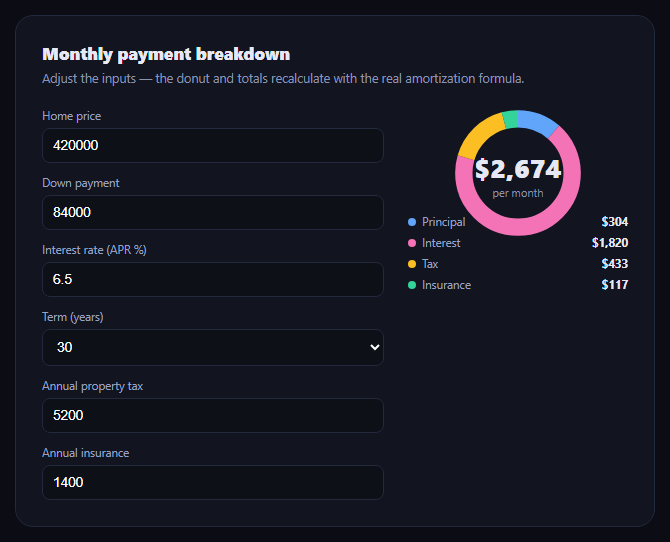
Most "mortgage calculator" widgets show a single monthly number and stop there. This one shows the four pieces that number is actually made of — principal, interest, taxes, and insurance (PITI) — on a donut chart that redraws live as home price, down payment, rate, and term change, using the real fixed-rate amortization formula rather than an approximation.
The actual amortization formula
The principal-and-interest portion comes from M = P × [r(1+r)^n] / [(1+r)^n - 1], where P is the loan principal (home price minus down payment), r is the monthly interest rate (annual rate ÷ 12), and n is the total number of monthly payments (years × 12). This is the standard closed-form fixed-rate mortgage payment formula — the same one a bank's own amortization schedule is built from, not a simplified stand-in.
Splitting one payment into principal and interest
A fixed monthly payment doesn't split evenly between principal and interest — early in the loan, interest dominates because the outstanding balance is largest. This snippet computes the first month's actual interest portion as principal × monthlyRate, then derives that month's principal portion as whatever's left of the payment. That's why, on a 30-year loan, the interest slice of the donut is often larger than the principal slice even though both come from the exact same fixed payment.
Tax and insurance, averaged monthly
Property tax and homeowner's insurance are typically billed annually or escrowed, so this snippet takes the annual figures you enter and divides each by 12 to get its monthly share — the same math a loan servicer uses to build a monthly escrow payment. Together with principal and interest, these four pieces sum to the full "PITI" payment shown in the center of the donut.
A donut driven by real dasharray math
The donut is four overlapping SVG circles sharing one center and radius, each using stroke-dasharray (visible arc length, visible-gap) and a stroke-dashoffset that accumulates from the previous segment's share — so the four arcs always tile the full circle exactly, with no gaps or overlaps, regardless of how the underlying dollar amounts shift.
Customizing it
Add PMI (private mortgage insurance, typically required below a 20% down payment) as a fifth slice, or swap the amortization formula for a variable-rate schedule. Pair it with mortgage calculator for a payment-only version, or property listing card for the listing this payment would apply to.
Step by step
How to Use
- 1Paste HTML, CSS, and JSA donut chart and input panel render with example values.
- 2Change the home price or down paymentThe loan principal and every slice recalculate.
- 3Adjust the interest rate or termWatch the principal/interest split shift accordingly.
- 4Edit tax or insuranceThose two slices grow or shrink independently of the loan math.
- 5Read the legendEach slice's exact monthly dollar amount is listed below the donut.
- 6Verify the totalThe center number is the sum of all four slices, PITI in full.
Real-world uses
Common Use Cases
Got questions?
Frequently Asked Questions
It's the real, standard fixed-rate amortization formula used by lenders: M = P × [r(1+r)^n] / [(1+r)^n − 1], where P is the loan principal, r is the monthly interest rate, and n is the total number of monthly payments. It is not simplified or approximated.
Because a fixed-rate loan's interest is calculated on the outstanding balance each month, and that balance is largest at the very start of the loan. Early payments are interest-heavy by design — as the balance shrinks over the loan's life, later payments become principal-heavy, even though the total monthly payment stays the same.
PITI stands for Principal, Interest, Taxes, and Insurance — the four components that typically make up a homeowner's full monthly mortgage payment when property tax and insurance are escrowed by the lender. This snippet computes and displays all four as separate donut slices rather than one combined number.
Not by default — PMI is typically required when the down payment is below 20% of the home price and would be a fifth slice. Add it by computing a monthly PMI estimate (commonly 0.5-1% of the loan annually) and including it in the total and the donut's slice list.
Move monthlyPrincipalAndInterest() and the slice-splitting logic into pure functions that take the input values and return the four amounts, then bind those to your framework's state and re-render the SVG stroke-dasharray/dashoffset values reactively instead of writing to the DOM directly.