

Swup Page Transition — Free Hooks-Driven Fade Transition Snippet
Swup Page Transition · Animations · Plain HTML, CSS & JS · Live preview
Copy & paste
Source Code
<div id="swup">
  <nav class="sw-nav">
    <span class="sw-logo">Journal</span>
    <a href="#entry-one" class="sw-link is-active" data-target="entry-one">Entry One</a>
    <a href="#entry-two" class="sw-link" data-target="entry-two">Entry Two</a>
  </nav>

  <div class="transition-fade" id="entry-one">
    <section class="sw-panel">
      <span class="sw-tag">Visit: entry-one</span>
      <h1>Swup in a single page</h1>
      <p>Click "Entry Two" — swup.hooks fires visit:start / content:replace / visit:end while a CSS class drives the actual fade, exactly like real Swup usage.</p>
    </section>
  </div>

  <div class="transition-fade" id="entry-two" hidden>
    <section class="sw-panel sw-panel--alt">
      <span class="sw-tag">Visit: entry-two</span>
      <h1>Second entry</h1>
      <p>On a real multi-page site this container would be replaced by fetched HTML from a second URL; here it's a sibling container toggled by the same hook sequence.</p>
    </section>
  </div>
</div>*{box-sizing:border-box;margin:0;padding:0}
body{font-family:system-ui,-apple-system,sans-serif;background:#0c0b14;color:#fff;min-height:100vh}
.sw-nav{display:flex;align-items:center;gap:22px;padding:20px clamp(20px,5vw,48px);border-bottom:1px solid #201d33}
.sw-logo{font-weight:800;letter-spacing:-.02em;margin-right:auto;font-size:16px}
.sw-link{color:#948bab;text-decoration:none;font-size:14px;font-weight:600;padding:6px 4px;border-bottom:2px solid transparent;transition:color .2s,border-color .2s}
.sw-link:hover{color:#fff}
.sw-link.is-active{color:#fff;border-color:#a78bfa}
.sw-panel{min-height:64vh;display:flex;flex-direction:column;justify-content:center;align-items:flex-start;gap:14px;padding:clamp(28px,7vw,72px);max-width:640px}
.sw-tag{font-size:11px;font-weight:700;letter-spacing:.08em;text-transform:uppercase;color:#d8b4fe;background:#2a123f;padding:4px 10px;border-radius:999px}
.sw-panel h1{font-size:clamp(30px,6vw,52px);letter-spacing:-.02em}
.sw-panel p{color:#a49cc0;font-size:16px;line-height:1.6}
.sw-panel--alt .sw-tag{color:#fbcfe8;background:#3a1030}
/* Swup's real convention: toggle a class during the transition and let CSS
own the actual animation timing via transition-duration. */
.transition-fade{opacity:1;transform:translateY(0);transition:opacity .35s ease,transform .35s ease}
.transition-fade.is-transitioning{opacity:0;transform:translateY(-16px)}// Swup's real API: a hooks event emitter you attach to, plus CSS classes it
// toggles during a visit (its term for one navigation). Production Swup
// intercepts link clicks, fetches the destination page over the network, and
// swaps the content inside its container while firing visit:start,
// content:replace, and visit:end around that swap. This sandbox has only one
// document, so there is no second page to fetch — instead we drive the same
// hook sequence and the same is-transitioning class toggle ourselves, on two
// containers that already both live on the page.
const swup = new Swup({ containers: ['#entry-one', '#entry-two'] });
const containers = {
'entry-one': document.getElementById('entry-one'),
'entry-two': document.getElementById('entry-two'),
};
const links = document.querySelectorAll('.sw-link');
// Real Swup usage: subscribe to lifecycle hooks the same way you would on a
// live multi-page site, purely for visibility into the visit lifecycle.
swup.hooks.on('visit:start', () => console.log('[swup] visit:start'));
swup.hooks.on('content:replace', () => console.log('[swup] content:replace'));
swup.hooks.on('visit:end', () => console.log('[swup] visit:end'));
links.forEach((link) => {
link.addEventListener('click', async (e) => {
e.preventDefault();
const target = link.dataset.target;
const current = document.querySelector('.transition-fade:not([hidden])');
const next = containers[target];
if (!current || next === current) return;
links.forEach((l) => l.classList.toggle('is-active', l === link));
swup.hooks.call('visit:start');
current.classList.add('is-transitioning');
await wait(350);
current.hidden = true;
swup.hooks.call('content:replace');
next.hidden = false;
next.classList.add('is-transitioning');
// Force a reflow so removing the class next frame actually transitions.
void next.offsetWidth;
next.classList.remove('is-transitioning');
await wait(350);
current.classList.remove('is-transitioning');
swup.hooks.call('visit:end');
});
});
function wait(ms) {
return new Promise((resolve) => setTimeout(resolve, ms));
}Extend with AI
Take This Snippet Further With AI
The AI prompt for this one is for Patreon supporters ($3 a month), along with a site with no ads. Supporters enter the passcode once and it is remembered in this browser.
What's included
Features
About this UI Snippet
Swup Page Transition — Hooks and CSS-Class Timing on In-Page Containers

Swup animates real page-to-page navigation: it intercepts internal link clicks, fetches the destination page's HTML, and swaps its containers into the DOM while firing lifecycle hooks — visit:start, content:replace, visit:end — around the swap. It leans on CSS to own the actual animation: Swup toggles an is-transitioning class and waits for the CSS transition-duration on that class before continuing, rather than animating with JavaScript directly. This snippet is a single HTML document with nothing to fetch, so it adapts that exact hooks-and-class pattern onto two containers already present in the page.
What's real Swup and what's adapted
new Swup({ containers: [...] }), the swup.hooks.on(...) subscriptions, and the transition-fade / is-transitioning class convention are exactly how Swup is used in production — that class-toggle timing model is Swup's actual design, not a simplification. What's adapted is the trigger: since there's no second URL to fetch, a click handler calls swup.hooks.call(...) at the same points Swup's own router would, and toggles hidden/is-transitioning on the two sibling containers instead of Swup replacing fetched content. Drop this onto a real multi-page site and you'd delete the manual toggling — Swup's router calls the hooks and swaps content itself.
CSS owns the timing, not JavaScript
Unlike a JS-driven tween, Swup's convention is to add a class and let the browser's own transition property determine how long the animation takes; Swup (and this adaptation) just waits that same duration before proceeding. That's why .transition-fade defines the opacity/transform transition and .is-transitioning defines the "leaving" state entirely in CSS — change the transition timing function or duration in one place and the whole visit lifecycle respects it automatically.
The hook sequence
visit:start fires as a visit begins (here, on click); content:replace fires the moment the new content is swapped in (here, when the next container is un-hidden); visit:end fires once the entering transition finishes. Subscribing via swup.hooks.on is how you'd hang a loading bar, analytics ping, or scroll-reset off any point in a real Swup-powered navigation.
Where this fits
For the same navigation-transition problem solved with a different library and a transitions-array hook shape instead of an event emitter, see Barba.js page transition. For scroll-triggered rather than navigation-triggered motion, see scroll reveal grid.
Customizing it
Add more containers, change .is-transitioning's transform for a different exit direction, or hang extra behavior off content:replace (like resetting scroll position, which real Swup does by default). In production, Swup's containers option targets CSS selectors present on both the current and fetched page, so naming them consistently across templates is what makes the swap work at all.
Step by step
How to Use
- 1Add the Swup CDNInclude swup.umd.js from the CDN panel.
- 2Paste HTML, CSS, and JSA nav and two containers render, one hidden.
- 3Open the console (optional)See visit:start / content:replace / visit:end log.
- 4Click "Entry Two"The current container fades out via is-transitioning.
- 5Watch the swapThe next container fades in on the same class toggle.
- 6Adapt for productionRemove the click shim; let Swup's router own navigation.
Real-world uses
Common Use Cases
visit:start, content:replace and visit:end exactly as production does.transition-duration on a class instead of a JavaScript tween.Got questions?
Frequently Asked Questions
Swup is genuinely instantiated with new Swup({ containers: [...] }) and its real hooks event emitter is used to subscribe to and fire visit:start, content:replace, and visit:end. What's adapted is only the trigger: since this sandbox has no second URL to fetch, a click handler calls those same hooks and toggles which container is visible, instead of Swup's own fetch-based router doing it — the hook names, timing, and CSS class convention are unchanged from production usage.
You would remove the manual hidden-toggling and the direct swup.hooks.call() invocations. Swup's own router would intercept clicks on internal links, fetch the destination page, replace the content inside the matching container selector, and fire the lifecycle hooks itself around that swap — your CSS transition-fade / is-transitioning classes would carry over completely unchanged, since that part of the pattern was never adapted.
That's Swup's actual design: it adds an is-transitioning (or similarly named) class and then waits for the CSS transition-duration defined on that class before proceeding to the next step, rather than running its own tween engine. This keeps the animation authored entirely in CSS — change the transition property in one place and the whole page's visit timing follows it, no JS animation values to keep in sync.
In production Swup, content:replace fires at the exact moment the fetched page's HTML has been swapped into the container, after the leaving transition finishes and before the entering transition starts. In this adaptation, it fires when the next container is un-hidden and about to animate in — the same position in the sequence, just triggered manually instead of by Swup's own DOM-replacement step.
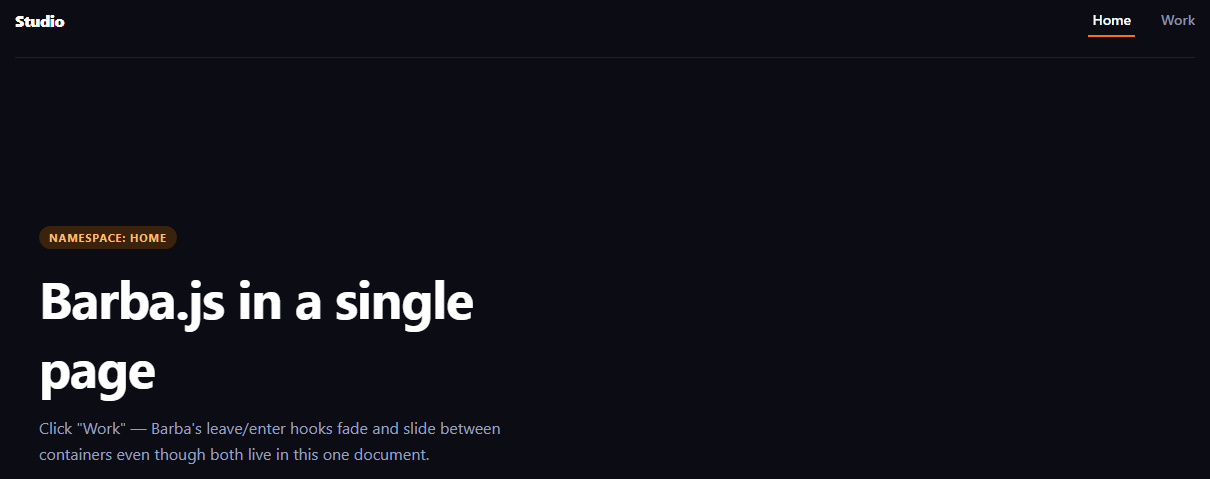
Both solve the same problem — animated transitions between page loads — with different APIs: Swup exposes a hooks event emitter (swup.hooks.on/call) and lets CSS transition-duration drive timing via class toggles, while Barba.js uses a transitions array of leave/enter functions that each return a promise it awaits. See the companion Barba.js page transition snippet for the same in-page adaptation built on that API instead.