



Testimonial Wall — Free HTML CSS JS Marquee Snippet
Testimonial Wall · Cards · Plain HTML, CSS & JS · Live preview
Copy & paste
Source Code
<section class="tw-section">
  <h2 class="tw-head">Loved by builders</h2>
  <div class="tw-wall" id="twWall" aria-label="Customer testimonials">
    <div class="tw-col" data-speed="38"></div>
    <div class="tw-col" data-speed="50"></div>
    <div class="tw-col tw-hide" data-speed="44"></div>
  </div>
</section>*{box-sizing:border-box;margin:0;padding:0}
body{font-family:system-ui,-apple-system,sans-serif;background:#0a0a0f;color:#e7e7ef}
.tw-section{max-width:1040px;margin:0 auto;padding:48px 18px}
.tw-head{text-align:center;font-size:clamp(24px,5vw,38px);font-weight:800;letter-spacing:-.02em;margin-bottom:34px;background:linear-gradient(120deg,#fff,#a78bfa);-webkit-background-clip:text;background-clip:text;color:transparent}
.tw-wall{display:grid;grid-template-columns:repeat(3,1fr);gap:16px;height:560px;overflow:hidden;position:relative;-webkit-mask-image:linear-gradient(180deg,transparent,#000 12%,#000 88%,transparent);mask-image:linear-gradient(180deg,transparent,#000 12%,#000 88%,transparent)}
.tw-col{display:flex;flex-direction:column;gap:16px;will-change:transform}
.tw-card{background:#15151f;border:1px solid #26263a;border-radius:14px;padding:17px;flex-shrink:0}
.tw-quote{font-size:13.5px;line-height:1.6;color:#cfcfe0}
.tw-who{display:flex;align-items:center;gap:10px;margin-top:13px}
.tw-av{width:34px;height:34px;border-radius:50%;flex-shrink:0;display:flex;align-items:center;justify-content:center;font-weight:800;font-size:13px;color:#0a0a0f}
.tw-name{font-size:12.5px;font-weight:700;color:#fff}
.tw-role{font-size:11px;color:#8b8ba3}
.tw-stars{color:#fbbf24;font-size:12px;letter-spacing:1px;margin-bottom:9px}
@media(max-width:760px){.tw-wall{grid-template-columns:repeat(2,1fr);height:520px}.tw-hide{display:none}}
@media(max-width:480px){.tw-wall{grid-template-columns:1fr}}var DATA = [
{ q: 'Shipped our marketing site in a weekend. The snippets just drop in.', n: 'Mara Okafor', r: 'Founder, Tilt', c: '#a78bfa' },
{ q: 'The export-to-React button saved me hours of porting plain HTML.', n: 'Devon Reyes', r: 'Frontend Lead', c: '#22d3ee' },
{ q: 'Finally a library that is real UI, not yet another color converter.', n: 'Priya Nair', r: 'Design Engineer', c: '#f472b6' },
{ q: 'Copy, paste, customize. My team uses it as a starter every sprint.', n: 'Liam Chen', r: 'CTO, Forge', c: '#34d399' },
{ q: 'Accessible defaults out of the box meant fewer audit fixes later.', n: 'Sofia Marenco', r: 'Accessibility Eng.', c: '#fbbf24' },
{ q: 'The dark, modern aesthetic matched our brand with zero restyling.', n: 'Noah Patel', r: 'Product Designer', c: '#60a5fa' },
{ q: 'I prototype client pitches twice as fast now. Total game changer.', n: 'Ava Lindqvist', r: 'Freelancer', c: '#fb7185' },
{ q: 'Vanilla JS means no dependency headaches in our legacy stack.', n: 'Marcus Bauer', r: 'Staff Engineer', c: '#c084fc' },
{ q: 'Our conversion bump came straight from these polished components.', n: 'Yuki Tanaka', r: 'Growth, Bloom', c: '#2dd4bf' }
];
function cardHTML(t) {
var initials = t.n.split(' ').map(function (w) { return w[0]; }).join('');
return '<div class="tw-card"><div class="tw-stars">★★★★★</div>' +
'<p class="tw-quote">' + t.q + '</p>' +
'<div class="tw-who"><span class="tw-av" style="background:' + t.c + '">' + initials + '</span>' +
'<span><span class="tw-name">' + t.n + '</span><br><span class="tw-role">' + t.r + '</span></span></div></div>';
}
var cols = Array.prototype.slice.call(document.querySelectorAll('.tw-col'));
cols.forEach(function (col, i) {
// Each column gets a rotated slice of the data, then a duplicate set so the
// loop is seamless: when we scroll exactly one set height, we reset to 0.
var slice = DATA.slice(i * 3).concat(DATA.slice(0, i * 3));
var html = slice.map(cardHTML).join('');
col.innerHTML = html + html;
var speed = parseFloat(col.getAttribute('data-speed')); // px per second
var offset = i % 2 ? -1 : 1; // alternate direction
var pos = 0, half = 0, paused = false, last = performance.now();
requestAnimationFrame(function measure() { half = col.scrollHeight / 2; });
col.addEventListener('mouseenter', function () { paused = true; });
col.addEventListener('mouseleave', function () { paused = false; });
function tick(now) {
var dt = (now - last) / 1000; last = now;
if (!half) half = col.scrollHeight / 2;
if (!paused) {
pos += speed * dt * offset;
if (pos <= -half) pos += half; // wrap upward scroll
if (pos >= 0) pos -= half; // wrap downward scroll
col.style.transform = 'translateY(' + pos + 'px)';
}
requestAnimationFrame(tick);
}
requestAnimationFrame(tick);
});Extend with AI
Take This Snippet Further With AI
The AI prompt for this one is for Patreon supporters ($3 a month), along with a site with no ads. Supporters enter the passcode once and it is remembered in this browser.
What's included
Features
About this UI Snippet
Testimonial Wall — Infinite Scrolling Social-Proof Columns
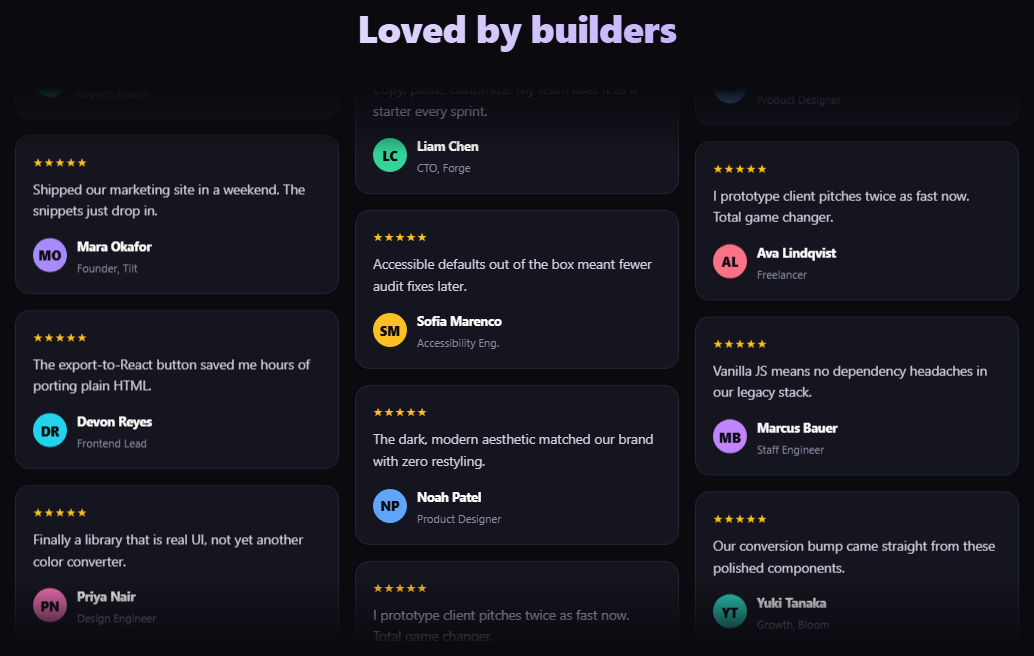
The testimonial wall is the social-proof section every modern landing page reaches for: multiple columns of review cards that scroll vertically and endlessly, each column drifting at a slightly different speed so the motion feels organic rather than mechanical. This snippet builds the whole effect — seamless looping, edge fades, alternating directions, and pause-on-hover — in plain HTML, CSS, and vanilla JavaScript with no animation library.
Seamless infinite loop
The trick to an endless scroll is duplication. Each column renders its set of cards twice (col.innerHTML = html + html), and the animation translates the column upward. The instant the offset reaches exactly one set's height — measured as scrollHeight / 2 — the position wraps by adding that height back, which is visually identical because the second set is a perfect copy of the first. The viewer never sees a seam or a reset jump; the cards appear to flow forever.
A real-time animation loop
Rather than a fixed CSS keyframe, the motion runs on requestAnimationFrame with delta timing. Each frame computes dt, the seconds since the previous frame, and advances the position by speed * dt. Because it is time-based instead of frame-based, the scroll runs at the same real-world velocity whether the display is 60Hz or 120Hz, and a dropped frame doesn't cause a stutter in distance traveled. Each column reads its own data-speed (in pixels per second), so the three columns drift at 38, 50, and 44 px/s for that layered, living feel.
Alternating directions
The middle column scrolls the opposite way from its neighbors via an offset of -1 versus 1. The wrap logic handles both: when scrolling up, the position resets after passing -half; when scrolling down, it resets after crossing 0. This two-way wrap means a single loop body supports both directions without special-casing.
Edge fade with a mask
To avoid hard cut-offs where cards appear and disappear, the wall uses a CSS mask-image: linear-gradient(180deg, transparent, #000 12%, #000 88%, transparent). The mask fades the top and bottom 12% of the container to transparent, so cards melt in and out at the edges instead of popping. This is a pure compositing effect — no extra overlay elements and no impact on layout.
Pause on hover
Each column listens for mouseenter and mouseleave to set a paused flag. While paused, the animation loop keeps running but skips the position update, so a visitor can stop a column and actually read a testimonial — then it resumes exactly where it left off. This is the small touch that turns a decorative marquee into something usable.
Data-driven cards
All testimonials live in one DATA array of quote, name, role, and accent color. A cardHTML function builds each card, deriving the avatar's initials from the name automatically. Each column gets a rotated slice of the array so the three columns don't show the same quotes in the same order. To wire it to real reviews, replace DATA with your API response — the rendering and looping need no changes.
Customizing it
Adjust the data-speed values for faster or calmer motion, change the mask percentages to widen or tighten the fade, add a fourth column on wide screens, or hide the third column on tablets (the snippet already drops to two columns under 760px and one under 480px). Pair it with a rating breakdown summary or a logo marquee for a complete social-proof block.
Step by step
How to Use
- 1Paste HTML, CSS, and JSThree columns of review cards scroll vertically and endlessly.
- 2Watch the layered motionEach column drifts at a different speed and the middle one reverses.
- 3Note the edge fadesCards melt in and out at the top and bottom via a CSS mask.
- 4Hover a columnIt pauses so you can read a testimonial, then resumes.
- 5Swap in real reviewsReplace the DATA array with your own quotes and avatars.
- 6Tune speeds and fadeEdit data-speed and the mask percentages to taste.
Real-world uses
Common Use Cases
requestAnimationFrame loop with delta timing, so speed stays constant across screen refresh rates.Got questions?
Frequently Asked Questions
Each column renders its cards twice and scrolls by translateY. When the offset reaches one set's height (scrollHeight / 2), the position wraps by adding that height back. Because the second set is an exact copy of the first, the reset lands on an identical frame, so the loop is seamless.
The rAF loop uses delta timing — it advances by speed times the elapsed seconds each frame — so the velocity is identical on 60Hz and 120Hz displays and survives dropped frames. It also makes pause-on-hover trivial: the loop keeps running but skips the position update while a paused flag is set.
The wall has a CSS mask-image set to a vertical linear-gradient that is transparent at the very top and bottom and opaque in the middle. The mask hides the top and bottom 12% of pixels, so cards fade in and out at the edges with no extra overlay elements and no effect on layout.
Yes. All content lives in the DATA array of quote, name, role, and color. The cardHTML function derives avatar initials from the name automatically. Replace DATA with your reviews API response and the duplication, looping, and masking all keep working unchanged.
Render the columns from your data and keep the rAF loop in a mount effect, storing the animation frame id so you can cancel it on unmount (useEffect cleanup in React, onUnmounted in Vue, ngOnDestroy in Angular). Use refs for the column elements rather than getElementById. The CSS — including the mask-image — ports directly, and in Tailwind the fade can use [mask-image:...] arbitrary values.