
Desktop · 1280px · shown at 0% · edit the text, images and colours in the panel
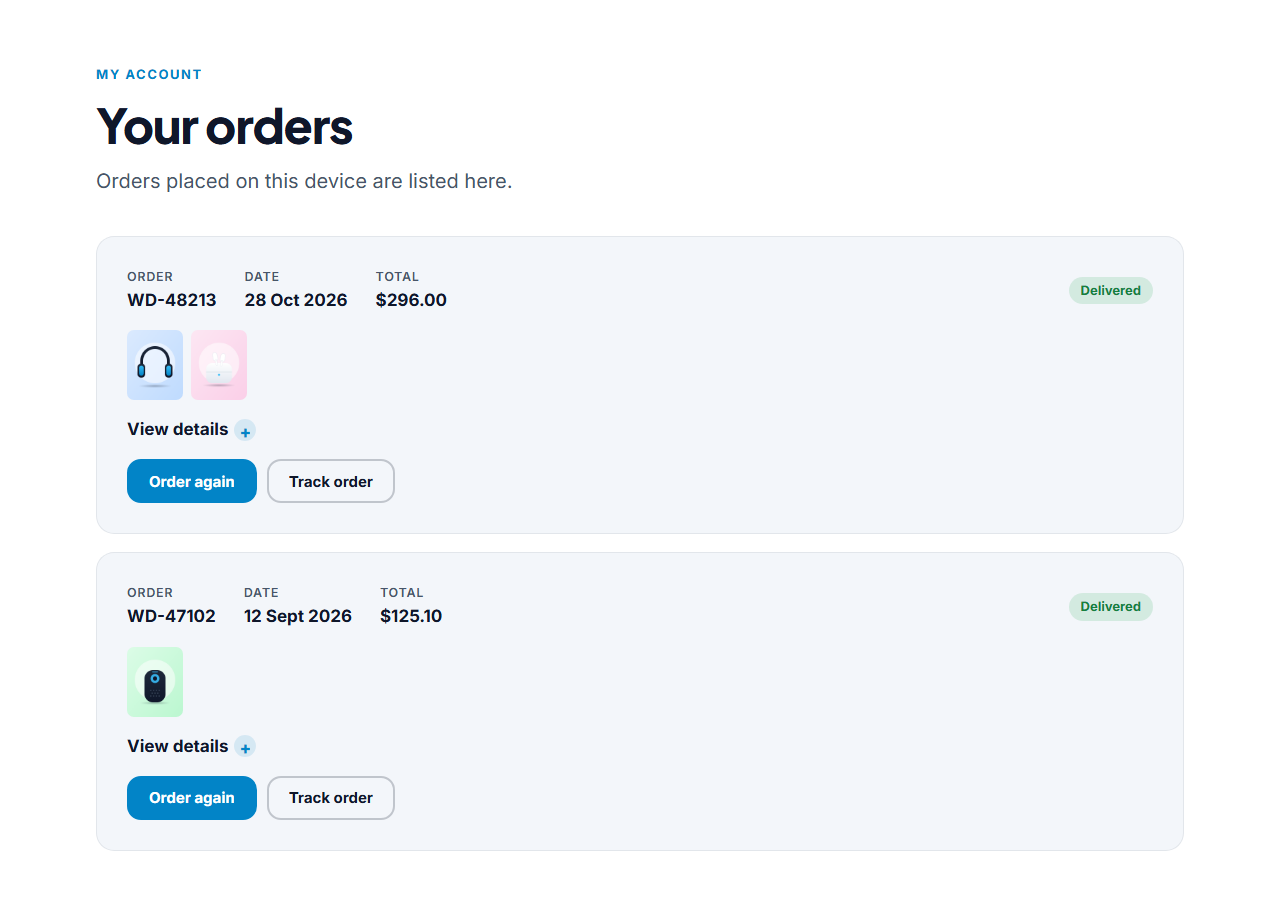
Order History (My Orders)
Responsive · Animated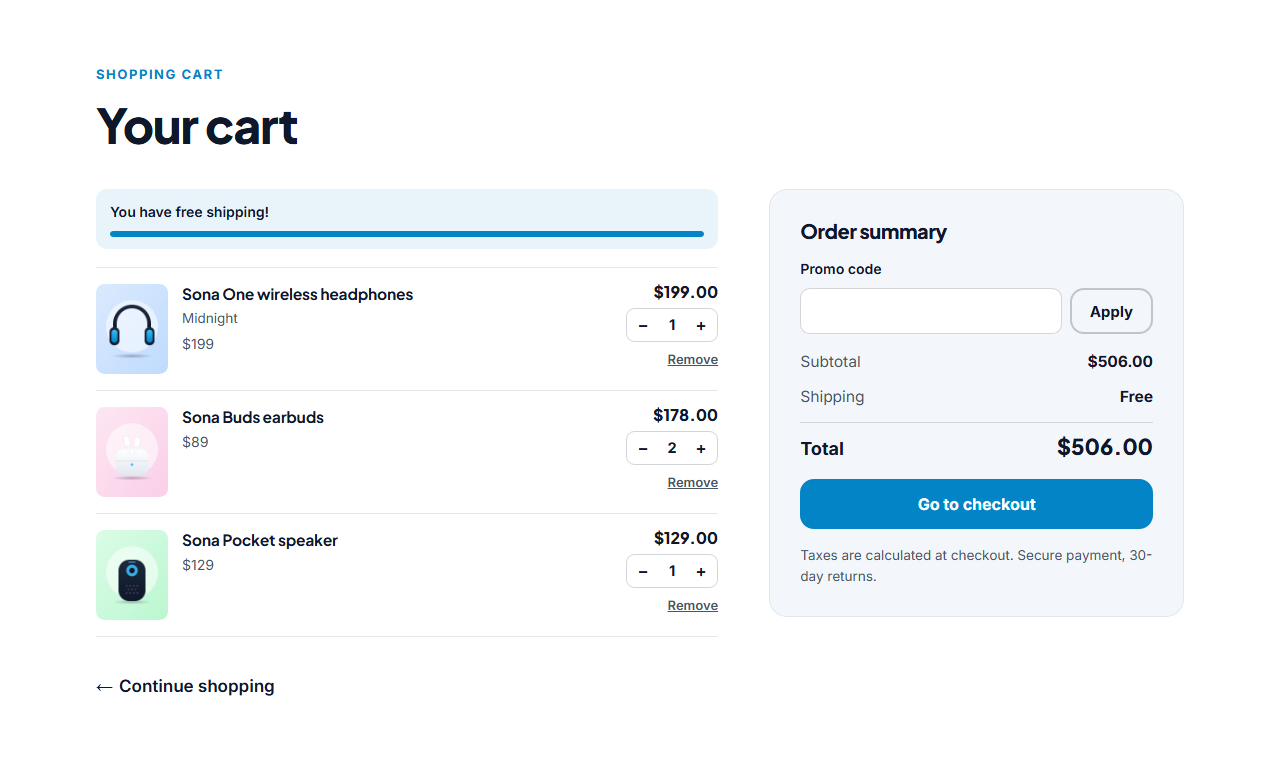
Cart Page
Responsive · Animated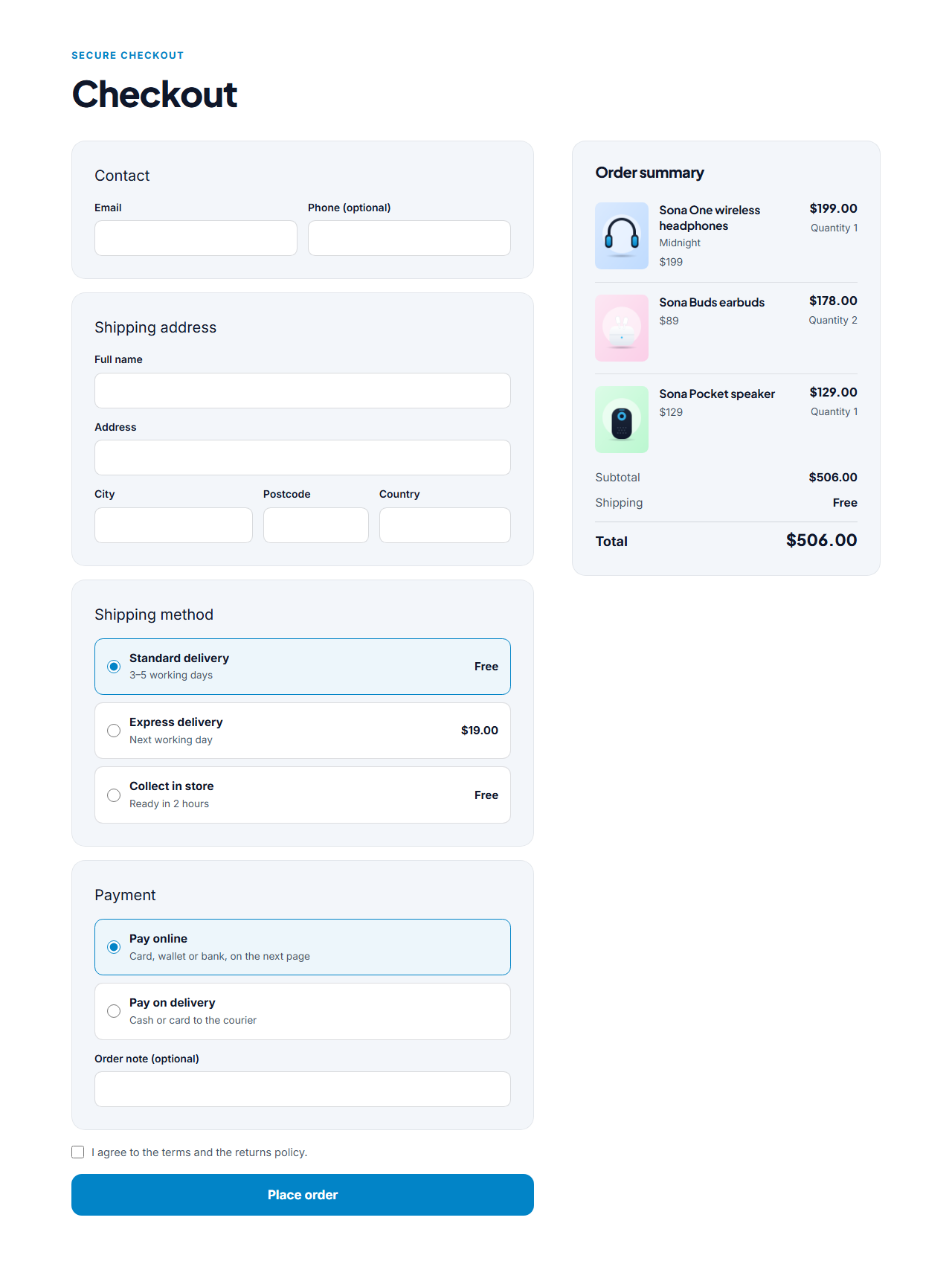
Checkout Page
Responsive · Animated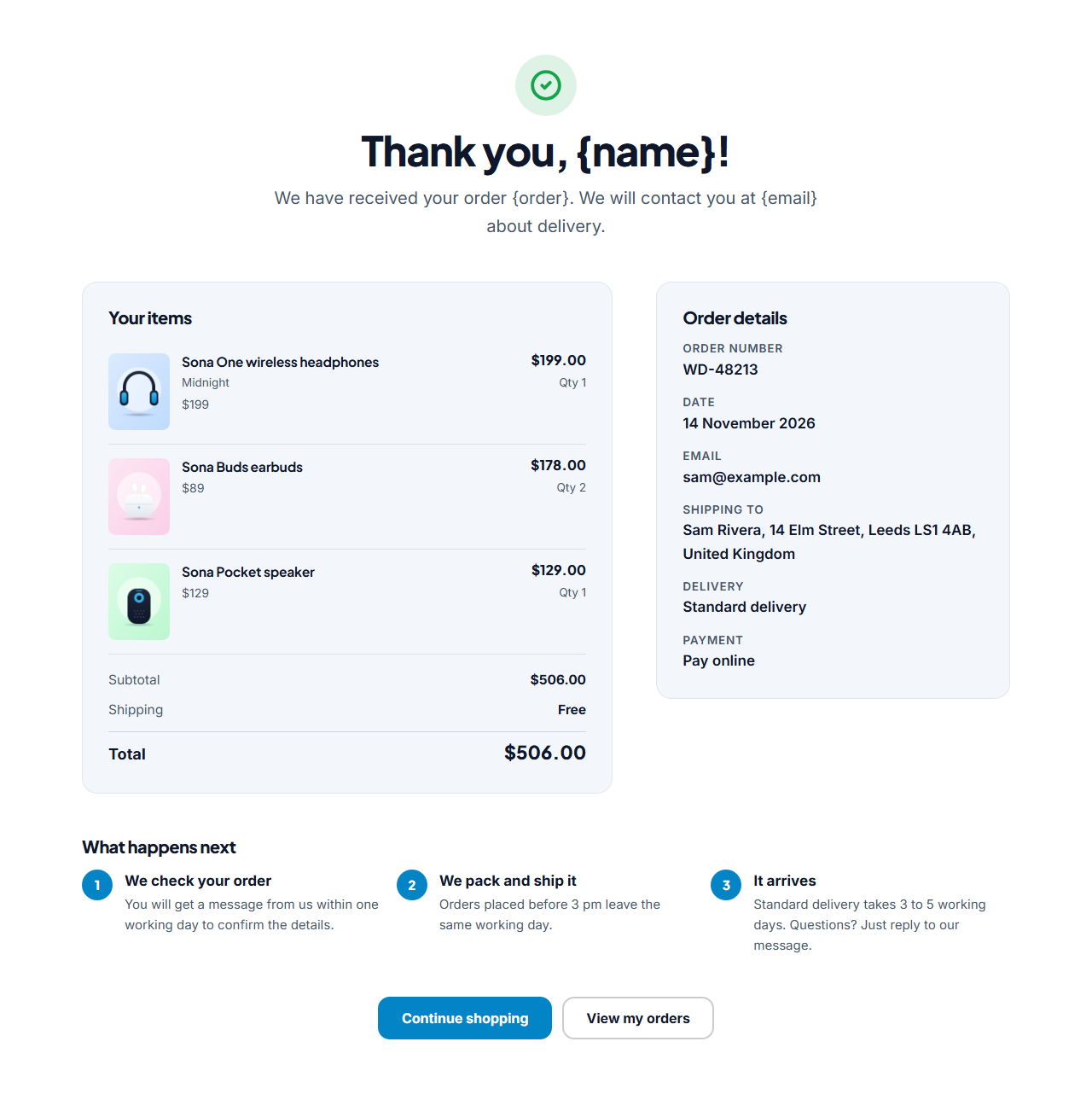
Order Confirmation (Thank You)
Responsive · Animated
Wishlist Page
Responsive · AnimatedOrder History (My Orders) — Free Website Section Template
Cart, checkout & orders · v1.0.0 · Updated 2026-11-14 · Responsive · GSAP animation · HTML, React & Vue
Extend with AI
Take This Section Further With AI
Ask an AI assistant to adapt the page: add invoice download, return requests, a status timeline or orders from your own API.
Prompt to recreate it
Copy this into your AI assistant of choice to build the effect from scratch, or as a jumping-off point for your own variant:
Create a "My orders" page in plain HTML, CSS and JavaScript that lists orders saved in localStorage (newest first).

- Each order is a card with a row of facts (order number, date, total), a status badge, product thumbnails with an item count, a <details> element ("View details") containing the items, delivery address, shipping method, payment and totals, and buttons: "Order again" (add all items back to the cart and open the cart) and an optional "Track order" link that adds ?order=ID to a tracking URL.
- An empty state with a Start shopping button.
- Build the DOM with createElement and textContent only.
Want to tighten it up first? Run this prompt through the AI Prompt Studio to score it across 8 quality dimensions, catch anti-patterns, and tune the wording for Claude, ChatGPT, or Gemini before you paste it in.
What's included
Features
About this section
Order History — Free My Orders Page Template
Order History is a free "My orders" page for past purchases. Each order is a card with the order number, date, status and total, a row of product photos, and a details view with every item, the totals, the delivery address and the payment choice. An Order again button puts the same items back in the cart, and an optional Track order link points to your tracking page. Orders come from the Checkout Page and are saved in the shopper's browser, so no account is needed.
Reorder in one click
Repeat purchases are the cheapest sales you will ever make. Order again adds every item of a past order to the cart and opens the Cart Drawer, or goes to the cart page, ready for checkout.
Honest about what it knows
The plain version knows only what the browser saved, so a new order carries the status you set in the editor (for example "Order received") and orders from other devices do not appear. For real statuses and tracking, link the Track order button to your own tracking page or your shop platform, and see the optional accounts idea on the roadmap.
Details when needed
The details view is a native details element, so it works with the keyboard and screen readers, and prints well. In the editors the page shows two demo orders.
Edit and export
Edit every label, the status text, the buttons and the empty state, and export HTML, a ZIP, React or Vue.
Why use it
Why Use the Order History (My Orders)
How it’s different
How It’s Different From Other Free Section Templates
Step by step
How to Use
- 1Edit the contentFill in the heading, order cards, no orders yet and labels (screen readers) in the panel. Wrap words in *asterisks* to colour them.
- 2Add your imagesUpload your own images (resized in your browser and kept on your device) or paste a hosted image URL.
- 3Match your brandPick a colour preset or exact colours, choose heading and body fonts from Google Fonts or your own uploaded font, set the corner radius and width, or apply your brand kit.
- 4Animate and previewChoose a GSAP entrance effect and speed, press Play animation, and check the section on desktop, tablet and mobile.
- 5Save and exportSave it to My designs, then export a single HTML file, a ZIP with your images, a React or Vue component, or fork it into My Code.
Real-world uses
Common Use Cases
Got questions?
Frequently Asked Questions
Without accounts or a server, the only place an order can be saved is the visitor's browser. Orders placed on another device or browser will not appear. Accounts are on the roadmap as an optional upgrade.
New orders show the status text you set, such as Order received. For real statuses link the Track order button to your own tracking page or shop platform, which knows where the parcel is.
It adds every item of that order to the cart with the same options and quantities, then opens the cart drawer or the cart page.
The 25 most recent orders placed in this browser.
It saves an editable copy of your Order History (My Orders) in My Code, the UI Snippets code editor: the section markup goes in the HTML panel, its CSS (theme variables, base styles and layout) in the CSS panel, and the GSAP library is added as a CDN link, so you can keep refining the code and save your own versions.
Yes. Every section is free for personal and commercial work, with no account, no watermark and no attribution: export it on its own as HTML, React, Vue or Next.js from its page, or use it in a website you build and export in the Website Builder.